Google's New AI Breakthrough Teaches Computers to See Like Humans
The Blind Spot in AI Vision
Ask most AI systems what's in a picture, and they'll describe it beautifully. But pose a trickier question like "Where's the panda's left hind leg?" and the confidence wavers. This isn't just one model's shortcoming - it's a fundamental limitation across the entire field of visual AI. Computers excel at broad comprehension but struggle with pinpoint accuracy.
Three Innovations Behind TIPSv2
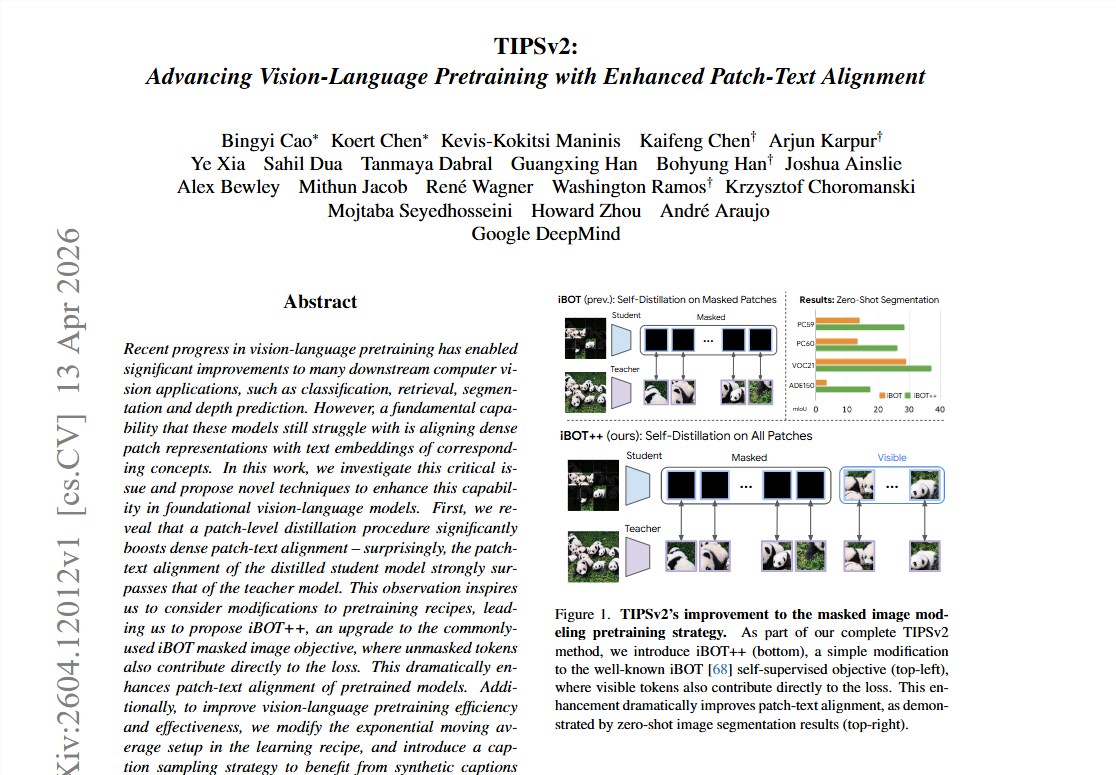
Google DeepMind's research team made a surprising discovery: smaller AI models sometimes outperform their larger counterparts in detailed image analysis. This counterintuitive finding sparked the development of TIPSv2, which combines three key advancements:
1. The 'Entire Textbook' Approach (iBOT++) Traditional AI training resembles doing jigsaw puzzles with half the pieces missing. The new iBOT++ method forces the system to learn every image detail, like studying an entire textbook rather than random excerpts. This single change boosted segmentation accuracy by over 14%.
2. Slimmer, Faster Training (Head-only EMA) Previous methods required maintaining two heavyweight models simultaneously - like carrying twin backpacks up a mountain. TIPSv2's clever modification keeps just one full model while efficiently training the final "decision-making" layer separately, reducing computing needs by 42% without sacrificing performance.
3. Multilevel Learning Imagine teaching a student with only children's books or exclusively PhD theses. TIPSv2 avoids both extremes by mixing simple captions, moderate descriptions, and Gemini-generated detailed analyses during training. This keeps the AI challenged at just the right level.
Real-World Impact
The results speak for themselves. Across 20 benchmark tests, TIPSv2 set new standards in zero-shot segmentation while outperforming larger models in image retrieval and classification. Even pure visual tasks saw significant improvements.
What makes this particularly exciting is the team's decision to open-source the technology. From radiologists examining X-rays to engineers developing autonomous vehicles, professionals relying on precise image understanding now have access to cutting-edge tools.
Key Points:
- Solves AI's "big picture vs. details" dilemma
- Combines three novel techniques for comprehensive learning
- 42% more efficient training than previous methods
- Outperforms larger models in multiple benchmarks
- Fully open-sourced for practical applications