Google's AI Power Play: New TPUs and Agent Platform Reshape Business Tech
Google Doubles Down on Enterprise AI with Hardware and Software Push
At this year's Cloud Next conference, Google made its boldest move yet in the enterprise AI race. Rather than just chasing benchmark numbers, the tech giant unveiled a complete ecosystem designed to bring AI assistants from the lab to the office floor.
The Brains Behind the Operation: Smarter TPUs
The eighth-generation Tensor Processing Units (TPUs) mark a strategic shift. Google stopped trying to cram everything into one chip, instead creating two specialized versions:
- TPU8t for heavy-duty model training
- TPU8i optimized for real-world inference tasks
What's really interesting? Google's not just making faster chips - they're building a brain trust. Their new Virgo network can link up to a million TPUs together, creating what might be the world's largest artificial neural network hardware cluster.
The inference-focused TPU8i packs clever upgrades like extra on-chip memory (perfect for today's popular mixture-of-experts models) and a novel Boardfly topology that slashes communication delays between chips. Translation: your AI assistant won't leave you hanging mid-sentence.
From Chatbots to Colleagues: The Gemini Platform
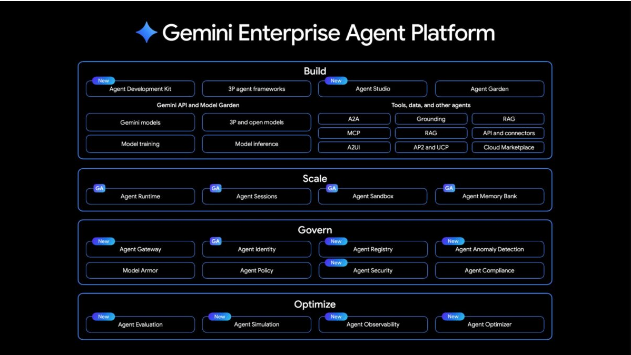
The real showstopper might be the Gemini Enterprise Agent Platform. Built on Vertex AI, it's essentially a factory for creating business-ready digital employees:
- Agent Studio lets these AIs remember conversations and handle multi-step processes without constant hand-holding
- New security tools address the elephant in the room - how to trust autonomous agents with sensitive data
- Workspace Intelligence connects the dots between Gmail, Docs, Drive and more, helping AIs understand how work actually flows in organizations
The platform even plays nice with third-party models like Claude Opus4.7, suggesting Google knows no single AI can do it all.
Why This Matters Now
We're past the phase where AI was just a novelty. With this launch, Google positions itself as the one-stop shop for companies wanting to deploy AI at scale - offering both the computational muscle and the software to make it useful.
The question isn't whether businesses will use AI, but how. Google's answer? Make it as seamless as hiring a new team member.
Key Points:
- Specialized silicon: Separate TPUs for training (TPU8t) and inference (TPU8i)
- Scale matters: Virgo network links up to 1 million TPUs
- Business-ready AI: Gemini platform handles security, memory and cross-app workflows
- Workspace integration: AIs that actually understand how office work gets done