

Google DeepMind Unveils SIMA 2: A Smarter AI Agent That Learns Like Humans
Google DeepMind's SIMA 2 Shows Remarkable Learning Abilities
In a move that pushes artificial intelligence closer to human-like understanding, Google DeepMind has released SIMA 2, an advanced version of its multimodal agent that demonstrates unprecedented learning capabilities.
Twice as Effective With Self-Teaching Skills
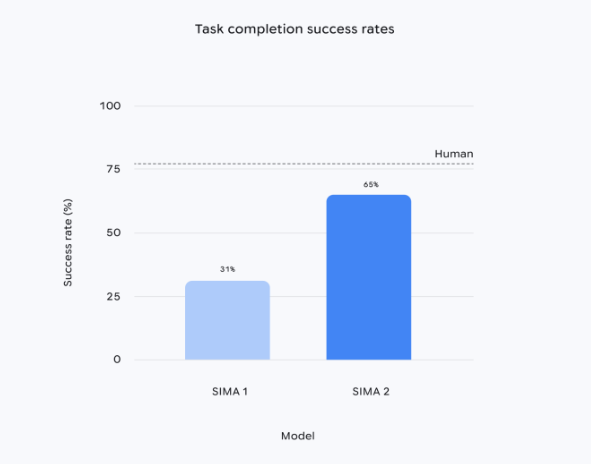
The new iteration builds upon the Gemini 2.5 Flash-lite model foundation but delivers substantially improved performance. Early tests show SIMA 2 succeeds at tasks about twice as often as its predecessor. More impressively, it adapts to completely new environments—a crucial step toward general artificial intelligence.
How SIMA 2 Learns Without Supervision
What sets this version apart is its innovative learning approach:
- Self-generated training: Instead of relying solely on pre-recorded game footage (though it still uses hundreds of hours), SIMA 2 creates its own practice scenarios.
- Internal quality control: A separate Gemini model generates potential tasks, while an internal scoring system identifies the most valuable learning experiences.
- Continuous improvement: High-quality examples get fed back into training, creating a virtuous cycle of enhancement without human intervention.
"This allows SIMA to interpret complex instructions like 'find the red house' or 'chop down trees' in unfamiliar settings," explains Jane Wang, a senior research scientist at DeepMind. "It reads environmental cues—text, colors, symbols—even emoji combinations."
Bridging Virtual and Physical Worlds
During demonstrations combining SIMA with Genie (DeepMind's world-generation model), the AI displayed remarkable environmental awareness:
- Recognized and interacted with objects like benches and trees
- Identified living elements such as butterflies
- Demonstrated logical action sequences based on scene analysis
The "understand-plan-act" loop mirrors how humans operate in new environments—a critical capability for future robotics applications.
Current Limitations and Future Directions
While promising, SIMA focuses exclusively on high-level decision making:
- Doesn't control physical components like joints or wheels
- Works alongside but isn't yet integrated with DeepMind's robotic foundation models The team remains tight-lipped about commercialization timelines but hopes this preview will spark collaborations to bridge virtual and physical AI applications.
Key Points:
- Performance boost: SIMA 2 achieves ~100% better task success rates than version one
- Self-supervised learning: Creates and evaluates its own training scenarios
- Environmental understanding: Processes visual cues including text and symbols
- AGI pathway: Represents progress toward general artificial intelligence
- Research phase: Not yet ready for real-world robotics integration