China's Qwen3.6 AI Model Goes Open-Source, Packing Big Power in Small Package

A New Contender in Open-Source AI

China's artificial intelligence landscape just got more interesting with the open-source release of Qwen3.6-35B-A3B on April 19th. This medium-sized model punches well above its weight class, combining impressive capabilities with remarkable efficiency.
Image

Small Size, Big Brain

What makes this release special? The model uses only 3 billion of its 35 billion parameters at any given time through an advanced Mixture of Experts (MoE) system. Imagine having a team of specialists where you only pay for the ones you need - that's essentially how this architecture works. For developers, this translates to getting premium performance without the premium computing bill.

"The efficiency gains here are substantial," explains Dr. Li Wei, an AI researcher at Tsinghua University. "You're getting results comparable to much larger models while using far fewer resources."

Benchmark Buster

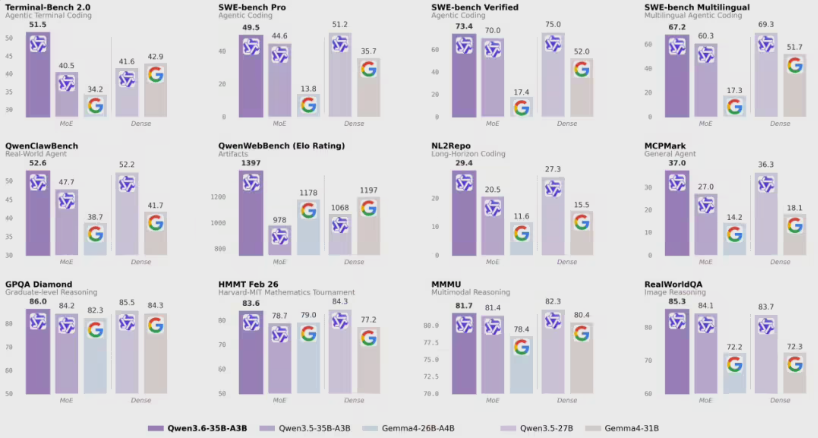
The numbers speak for themselves. In Terminal-Bench 2.0 (measuring programming skills) and real-world agent tests, Qwen3.6-35B-A3B doesn't just beat its predecessors - it challenges models twice its size. Its secret weapon? A "multimodal thinking" mode that processes visual information with human-like spatial understanding.

Want proof? Check its scores on RefCOCO, a tough image recognition challenge where it demonstrates scary-good comprehension of physical objects and their relationships.

Built for Real Work

This isn't just academic bragging rights. The developers have ensured deep compatibility with popular frameworks like OpenClaw and Claude Code. Translation: businesses can plug this into their existing systems relatively painlessly.

"We're seeing strong interest from manufacturing and logistics companies," notes Chen Yuan from Alibaba's DAMO Academy (the team behind Qwen). "The combination of programming smarts and visual understanding makes it ideal for automating complex workflows."

Get Your Hands Dirty

The best part? You don't need special access or deep pockets to try it out. The model is available now through:

  • Mogu Community
  • Hugging Face
  • Qwen Studio

For developers tired of choosing between performance and practicality, this might be the Goldilocks solution they've been waiting for.

Key Points:

  • Efficient architecture activates only 3B of 35B parameters at once
  • Outperforms larger models in programming and real-world agent tests
  • Multimodal capabilities handle both text and visual information
  • Ready for business with framework compatibility
  • Available now through major open-source platforms
Enjoyed this article?

Subscribe to our newsletter for the latest AI news, product reviews, and project recommendations delivered to your inbox weekly.

Weekly digestFree foreverUnsubscribe anytime

Related Articles

OpenAI's New Toolkit Makes AI Assistants Safer for Businesses
News

OpenAI's New Toolkit Makes AI Assistants Safer for Businesses

OpenAI has rolled out significant upgrades to its Agents SDK, giving developers better tools to create secure AI assistants. The standout feature is a sandbox environment that prevents unpredictable AI behavior from causing system-wide issues. Businesses can now test AI agents more safely while leveraging OpenAI's models. The update also introduces an integrated framework for smoother development, with Python support available now and TypeScript coming soon.

April 16, 2026
OpenAIAI DevelopmentEnterprise Technology
News

Xiaohongshu Shakes Up AI World by Open-Sourcing Its Relax Training Engine

In a surprising move, lifestyle platform Xiaohongshu has open-sourced its AI training engine called Relax, designed for multi-modal scenarios. This sophisticated tool handles text, images, audio and video through innovative parallel processing. The unexpected contribution from a non-traditional AI player signals the company's serious ambitions in artificial intelligence development and its desire to build influence in the tech community.

April 15, 2026
AIOpen SourceMachine Learning
HarmonyGNN: A Breakthrough in AI's Understanding of Complex Relationships
News

HarmonyGNN: A Breakthrough in AI's Understanding of Complex Relationships

A new AI training method called HarmonyGNN is revolutionizing how computers understand complex relationships in data. Developed by researchers at North Carolina State University, this technique helps neural networks better distinguish between different types of connections in graph data, achieving accuracy improvements up to 9.6%. The innovation could have significant implications for fields like drug discovery and weather forecasting.

April 14, 2026
Artificial IntelligenceMachine LearningGraph Neural Networks
Xiaomi's AI Model Joins Leading Open-Source Framework with Free Trial
News

Xiaomi's AI Model Joins Leading Open-Source Framework with Free Trial

Xiaomi has integrated its MiMo-V2 AI model series into the Hermes Agent framework, a major player in open-source AI development. Developers can now access Xiaomi's Pro, Omni, and Flash models for free for two weeks. This partnership combines Xiaomi's hardware expertise with Hermes' self-evolving capabilities, offering new possibilities for AI assistants. The move signals a shift in AI competition from conversational quality to execution efficiency.

April 10, 2026
XiaomiAI DevelopmentOpen Source
DeepSeek V4 Arrives Next Month: A Trillion-Parameter Powerhouse Built for China's AI Future
News

DeepSeek V4 Arrives Next Month: A Trillion-Parameter Powerhouse Built for China's AI Future

China's AI landscape is about to get a major upgrade. DeepSeek founder Liang Wenfeng has confirmed their next-generation V4 model will launch in late April 2026, packing trillion-parameter scale and breakthrough compatibility with domestic chips like Huawei's Ascend. This isn't just another model release - it's a strategic move that's already shaking up China's computing market, with tech giants stockpiling AI chips in anticipation. The model's 'Fast' and 'Expert' modes currently in testing hint at its versatile capabilities, from quick searches to complex problem-solving.

April 10, 2026
AI InnovationChina TechDeepSeek
Microsoft's Harrier Model Breaks Language Barriers with Open-Source Release
News

Microsoft's Harrier Model Breaks Language Barriers with Open-Source Release

Microsoft's Bing team has open-sourced its powerful Harrier multilingual embedding model, supporting over 100 languages. Trained on 2 billion examples plus GPT-5 synthetic data, this technology promises to revolutionize search and AI applications. Developers can now access three model sizes on Hugging Face, with integration planned for Bing and next-gen AI services.

April 8, 2026
MicrosoftNatural Language ProcessingOpen Source AI