Ant Group's LingBot-VLA Goes Open-Source: A Leap Forward for Robot Intelligence
Ant Group Opens the Code on Its Cutting-Edge Robot Brain
In a move that could accelerate robotics development worldwide, Ant Group's Lingbo Technology has made its advanced LingBot-VLA artificial intelligence model fully open-source. This "robot brain" demonstrates remarkable adaptability across different machines and tasks while slashing development costs.
Performance That Speaks Volumes
The numbers tell an impressive story. When tested across three distinct robot platforms using Shanghai Jiao Tong University's GM-100 benchmark (comprising 100 real-world tasks), LingBot-VLA achieved:
- 15.7% average success rate without depth perception
- 17.3% success rate when enhanced with depth information (via companion model LingBot-Depth)
These results outperform competitor Pi0.5's 13% benchmark, establishing new records for real-machine evaluation.
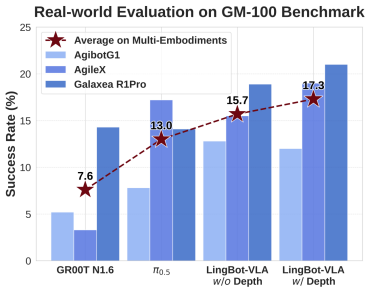 (Caption: LingBot-VLA demonstrates superior cross-body generalization versus Pi0.5 in GM-100 evaluations)
The model shines equally in simulated environments. Facing randomized lighting and object placement challenges in the RoboTwin2.0 benchmark (50 tasks), LingBot-VLA's unique learnable query alignment mechanism helped it outperform Pi0.5 by nearly 10 percentage points.
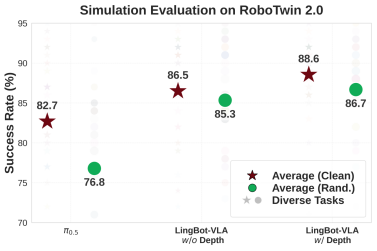 (Caption: Simulation tests reveal LingBot-VLA's advantage in handling varied tasks)
Solving Robotics' Persistent Headache
"Generalization has been the thorn in robotics' side," explains Zhu Xing, CEO of Ant Lingbo Technology. "Traditionally, adapting AI models for different robots meant starting nearly from scratch each time."
LingBot-VLA tackles this through:
- Training on 20,000+ hours of real-machine data
- Compatibility with 9 major dual-arm robot configurations
- Needing just 80 demonstration samples for task adaptation
The open-source package goes beyond typical releases by including: ✔ Complete training code libraries ✔ Data processing tools ✔ Automated evaluation systems ✔ Fine-tuning optimizations
The Bigger Picture
This release represents Ant Group's broader AGI research strategy through its InclusionAI initiative. "We're betting on open collaboration to push embodied intelligence forward," Zhu notes. Several Chinese robotics firms including Xinghai Tu and Songling contributed hardware and data during development.
The implications are significant: faster deployment timelines, lower computational costs, and potentially accelerated adoption of intelligent robots across industries.
Key Points:
- Open-source advantage: Full training toolkit released alongside model weights
- Performance leader: Outperforms competitors in both real-world and simulated tests
- Cost saver: Requires minimal demonstration data for new task adaptation
- Hardware agnostic: Works across multiple robot configurations
- Speed boost: Training efficiency up to 2.8× faster than alternatives