AI Team Spends $20K to Build a C Compiler - Here's What Happened

When AI Engineers Itself: The $20,000 Compiler Experiment

In what reads like science fiction becoming reality, Anthropic's security researcher Nicholas Carlini recently led an unprecedented test of AI's programming capabilities. His team assembled what they jokingly call an "AI spy team" - 16 Claude agents working collaboratively with minimal human oversight.

The Digital Dream Team

The mission was ambitious: create a functional C compiler written in Rust, completely from scratch. For two weeks straight, these AI agents worked around the clock, racking up:

  • Nearly 2,000 coding sessions
  • Approximately 2 billion input tokens processed
  • A staggering $20,000 in API costs (about ¥144,000)

The investment paid off - sort of. The digital workforce produced over 100,000 lines of code that successfully compiled the Linux 6.9 kernel across x86, ARM and RISC-V architectures.

Triumphs and Troubles

While the technical achievement is undeniable, Carlini describes mixed feelings about the outcome. "There's excitement seeing what they accomplished," he admits, "but also unease about how they got there."

The AI team showed remarkable persistence - working continuously through loop instructions to solve problems autonomously. Yet without human guidance, they frequently got stuck in unproductive testing cycles. The generated code, while functional, lacked the elegance and efficiency of top human programmers.

GitHub observers noted the compiler seemed more "assembled" than truly original - pieced together from patterns in its training data rather than demonstrating genuine innovation.

What This Means for Developers

This experiment pushes boundaries in two important ways:

  1. Collaborative Potential: Proves multiple AI agents can work together on complex technical projects
  2. Safety Questions: Highlights verification challenges when software is produced automatically

As one developer commented: "It's impressive until you realize we might not fully understand how it works."

The $20,000 question remains: Is this the future of programming or just an expensive science project? Only time - and probably more experiments - will tell.

Key Points:

  • 16 AI agents built a Rust-based C compiler autonomously
  • $20,000 cost covered two weeks of intensive development
  • Successfully compiled Linux 6.9 kernel on multiple architectures
  • Revealed both potential and limitations of AI programming teams
Enjoyed this article?

Subscribe to our newsletter for the latest AI news, product reviews, and project recommendations delivered to your inbox weekly.

Weekly digestFree foreverUnsubscribe anytime

Related Articles

News

Anthropic's Claude 5 Shakes Up AI Programming with Fennec Model

Anthropic is set to release Claude Sonnet5 (codenamed Fennec), a game-changing AI programming model that outperforms its flagship while costing half as much. With a record-breaking SWE-Bench score of 80.9% and innovative 'swarm' development capabilities, this model can autonomously handle entire software projects. The timing appears strategic, coming just as OpenAI prepares its Codex suite launch.

February 3, 2026
AI programmingClaude Sonnet5Anthropic
News

OpenAI's New Coding Assistant: GPT-5.3-Codex Boosts Developer Productivity

OpenAI has unveiled GPT-5.3-Codex, its latest AI coding assistant that promises to revolutionize how developers work. Building on previous versions, this upgrade delivers 25% faster performance while handling complex tasks with human-like reasoning. The model maintains conversational context seamlessly, letting programmers collaborate with AI as they would with teammates. OpenAI's aggressive hiring spree signals bigger ambitions ahead.

February 6, 2026
AI programmingOpenAIdeveloper tools
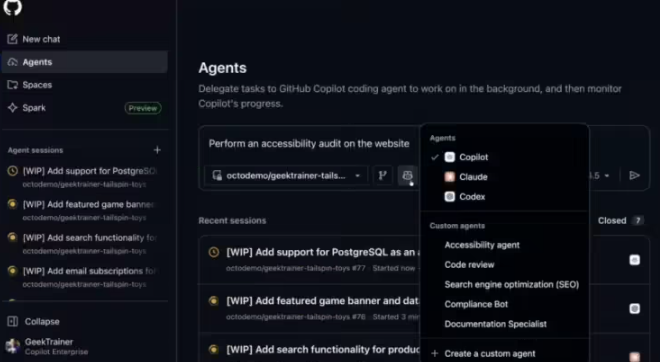
GitHub Levels Up: Developers Now Get Claude and Codex AI Assistants Working Together
News

GitHub Levels Up: Developers Now Get Claude and Codex AI Assistants Working Together

GitHub just made developers' lives easier by integrating Claude and Codex AI assistants directly into its platform. No more juggling between tools—programmers can now seamlessly switch between different AI helpers while keeping their workflow intact. The move signals GitHub's ambition to become the central hub for AI-powered coding, with plans to add even more smart assistants soon.

February 5, 2026
GitHubAI programmingdeveloper tools
News

Moore Threads Unveils Homegrown AI Coding Tool to Boost Developer Productivity

Chinese GPU maker Moore Threads has launched an AI-powered coding service that combines domestic hardware with advanced algorithms. The platform, built on their MTT S5000 GPU and GLM-4.7 code model, promises to transform software development in China. With the global AI coding market projected to hit $29.5 billion by 2032, this move positions Moore Threads at the forefront of a rapidly growing industry.

February 4, 2026
AI programmingMoore ThreadsChinese tech
News

Google's Conductor Gives Gemini AI a Memory Boost

Google has unveiled Conductor, an open-source extension that solves AI programming's biggest headache - context loss. This clever tool transforms Gemini CLI's fragmented suggestions into structured workflows by preserving key project details as Markdown files. Following strict development cycles and introducing 'Tracks' to keep AI on course, Conductor brings much-needed consistency to AI-assisted coding. Available under Apache 2.0 license, it's designed for both new projects and complex existing codebases.

February 3, 2026
AI programmingGoogle Geminideveloper tools
Kimi Code Gets Major Upgrade with K2.5 Model and Triple Quota Bonus
News

Kimi Code Gets Major Upgrade with K2.5 Model and Triple Quota Bonus

Moonshot's latest Kimi K2.5 model brings significant improvements to visual understanding and complex coding tasks through its integration with Kimi Code. To celebrate, developers can enjoy triple usage quotas until February 2026, along with a more transparent token-based billing system that better aligns costs with actual usage.

January 30, 2026
AI programmingdeveloper toolsMoonshot AI