
AI Hardware Boom: 145 Million Smart Robots and Drones Expected by 2035

The Rise of Physical AI: By the Numbers

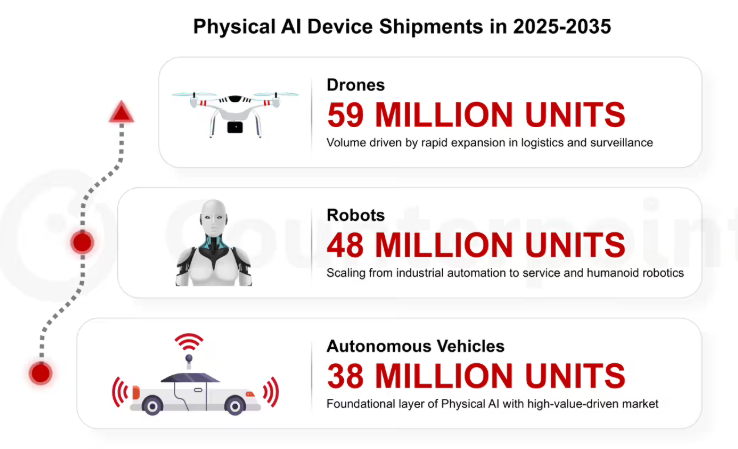
Move over smartphones - the next big hardware revolution will be AI-powered machines that move, sense, and interact with our world. According to Counterpoint Research's latest forecast, we're on track to see 145 million physical AI devices shipped globally between 2025 and 2035.
Image

Breakdown of the AI Hardware Wave

The numbers tell an interesting story:

  • Drones dominate with 59 million projected shipments
  • Robots follow closely at 48 million units
  • Autonomous vehicles trail at 38 million

But here's what's really catching industry attention - humanoid robots are growing at breakneck speed. These human-mimicking machines are expected to reach 100,000 installations by 2028, a sevenfold increase from 2025 levels.

"We're seeing humanoid robots transition from lab curiosities to practical workforce solutions," explains Peter Richardson, Vice President at Counterpoint. "Their ability to operate in human environments makes them uniquely versatile."

Why Drones Are Flying Ahead

While humanoids grab headlines, drones are quietly becoming the workhorses of physical AI. They've already found solid footing in:

  • Logistics (think Amazon deliveries)
  • Surveillance (from farm monitoring to border security)
  • Enterprise applications (industrial inspections, emergency response)

Their relatively simple form factor compared to humanoid robots makes drones easier to deploy at scale - a key reason they're outpacing other categories in adoption.

The Road Ahead for Autonomous Vehicles

Self-driving cars represent perhaps the most complex challenge in physical AI. Richardson notes: "Autonomous vehicles are pushing the boundaries of real-time decision-making. The technology stack - from sensors to connectivity - has to be flawless."

Despite the hurdles, the 38 million unit projection suggests confidence in gradual adoption, likely starting with controlled environments like shipping yards and highway trucking before reaching consumer vehicles.

Key Points:

  • 145 million physical AI devices expected to ship 2025-2035
  • Humanoid robots forecast to grow 7x by 2028 (100,000 units)
  • Drones lead adoption with 59 million shipments across logistics and surveillance
  • Autonomous vehicles face tougher challenges but show promise (38 million projection)
Enjoyed this article?

Subscribe to our newsletter for the latest AI news, product reviews, and project recommendations delivered to your inbox weekly.

Weekly digestFree foreverUnsubscribe anytime

Related Articles

News

Lenovo Bets Big on AI with New Smart Desktops Coming Next Year

Lenovo is making a bold move into AI hardware with plans to launch specialized 'AI Host' desktops in its 2026/2027 fiscal year. These aren't just powerful machines - they're designed from the ground up for AI workloads, backed by Lenovo's Tianxi ecosystem. The company also revealed strategies to help small businesses adopt AI more easily through its thinkplus brand and AaaS platform. This signals Lenovo's ambition to lead the transition from traditional PCs to AI-native devices.

April 10, 2026
LenovoAI HardwareBusiness Technology
Alibaba Campus Showcases Unitree's Humanoid Robot in E-Commerce Partnership Teaser
News

Alibaba Campus Showcases Unitree's Humanoid Robot in E-Commerce Partnership Teaser

Unitree's cutting-edge R1 humanoid robot made a surprise appearance at Alibaba's Hangzhou campus, hinting at an upcoming collaboration between the robotics firm and the e-commerce giant. The robot was seen performing human-like tasks, including operating a computer displaying the word 'Invitation,' sparking speculation about the 'ShuMaitong' project set to launch in mid-April. This partnership could revolutionize how Chinese robotics technology reaches global markets through Alibaba's established e-commerce platforms.

April 9, 2026
RoboticsE-CommerceTechPartnerships
News

Yushu Tech's Robot Vision Breakthrough: One LiDAR to Rule Them All

Yushu Technology has patented a clever mobile robot design that could change how machines see the world. Founder Wang Xingxing's team developed a semi-elliptical robot body with a single top-mounted LiDAR that outperforms traditional multi-sensor systems. This elegant solution cuts costs while improving data processing - proving sometimes less really is more in robotics.

April 7, 2026
RoboticsPatentNewsTechInnovation
News

ORCA Lab 1.0 Brings Physical AI Development to Your Laptop

Shanghai Songying Technology has unveiled ORCA Lab 1.0, China's first physical AI platform designed for individual developers. This groundbreaking tool eliminates the need for expensive hardware and complex coding, allowing anyone to create and train robots using just a standard laptop. The platform's no-code approach and full life cycle support could democratize embodied intelligence development, potentially accelerating innovation in this cutting-edge field.

April 3, 2026
Artificial IntelligenceRoboticsTech Innovation
News

Robot Revolution Nears: Unitree CEO Predicts ChatGPT Moment for Humanoids in Two Years

At the 2026 China Online Media Forum, Unitree Robotics CEO Wang Xingxing made waves by predicting humanoid robots will reach their 'ChatGPT moment' within two to three years. This breakthrough would allow robots to perform 80-90% of tasks through voice commands in unfamiliar environments. Wang emphasized that advanced movement capabilities form the foundation for practical robot labor, with major technological leaps expected this year in areas like tactile perception and multi-arm coordination.

March 30, 2026
RoboticsAI InnovationFuture Technology
News

Robots Get a Crash Course in Common Sense with New AI Model

DeepMind Intelligence has unveiled PhysBrain 1.0, a breakthrough AI model that teaches robots to understand physical laws like humans do. Unlike traditional approaches that simply mimic actions, this system grasps the underlying principles of how objects interact in space and time. Developed by Beijing's Zhongguancun tech hub, the technology could help robots adapt to unpredictable real-world environments with remarkable efficiency.

March 27, 2026
Artificial IntelligenceRoboticsMachine Learning