Shanghai's First Paralyzed Patient Controls Drinking with Brain Signals
Shanghai has reached a significant milestone in medical technology with the successful trial of a brain-machine interface, a breakthrough that could change the lives of paralyzed patients. On November 6, Huashan Hospital's neurosurgery department performed a pioneering clinical implantation of this innovative technology, which allows patients to regain some control over their movements using brain signals.
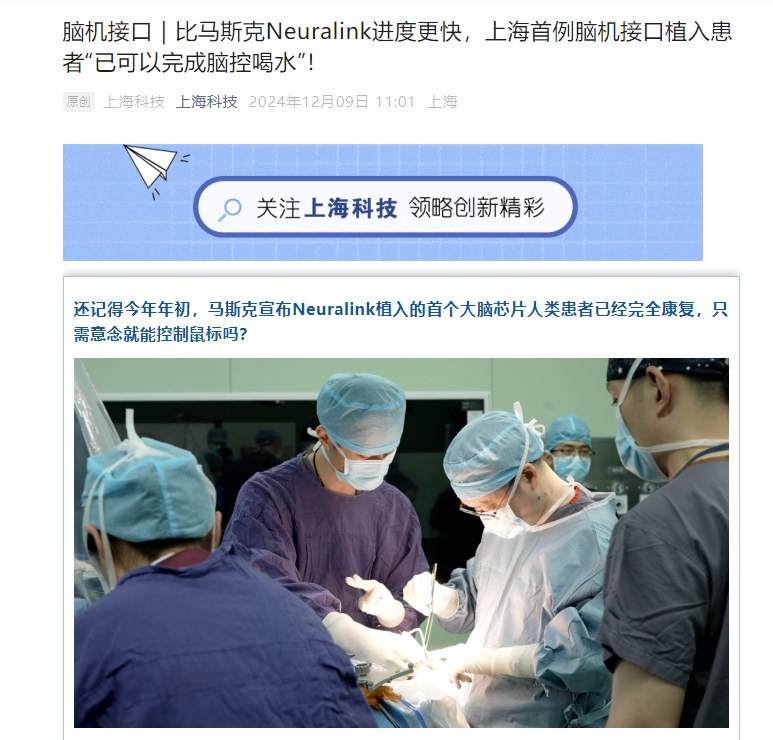
This state-of-the-art brain-machine interface was developed through a collaboration between Boruikang Medical Technology and Professor Hong Bo's team from Tsinghua University. The device allows paralyzed individuals to control external devices directly with their brain, bypassing the need for conventional physical input. The first patient to benefit from this technology, Xiao Dong, had been paralyzed for four years following an accident.
Unlike traditional brain-machine interfaces, which are invasive and often cause significant damage to brain tissue, this new system is designed to be minimally invasive. The device, about the size of a coin, is wireless and causes almost no harm to the brain. Remarkably, just one week after the surgery, Xiao Dong was discharged from the hospital, an indication of the technology's advanced design and minimal side effects.
The clinical trial, which was approved by the Huashan Hospital Ethics Committee, adhered to rigorous clinical trial standards for medical devices. It marked a significant leap forward in the potential for brain-machine interfaces to restore autonomy to those with severe disabilities. By November 15, Xiao Dong had already demonstrated the ability to control the action of drinking water with his brain signals, an achievement that many experts regard as a key milestone in the development of practical applications for brain-machine interfaces.
This groundbreaking advancement is seen as a major victory not only for medical technology but also for individuals living with physical disabilities. It opens new possibilities for rehabilitation and improved quality of life, offering renewed hope for those who had previously been unable to regain basic functions after paralysis.
The success of this clinical trial has garnered significant attention in the scientific community, with experts praising both the technological innovation and its potential societal impact. As the research progresses, it is expected that similar devices could become a standard part of treatment for individuals suffering from paralysis and other motor function disorders, paving the way for future breakthroughs in medical technology.
Key Points
- Shanghai's Huashan Hospital successfully completed a clinical trial of a brain-machine interface.
- The technology was developed by Boruikang Medical Technology and Tsinghua University’s Professor Hong Bo.
- The trial's first patient, Xiao Dong, was able to control drinking through brain signals just one week after surgery.
- The device is wireless, minimally invasive, and causes minimal damage to brain tissue, marking a significant advancement in medical technology.
- This breakthrough offers hope to millions of individuals with physical disabilities, potentially transforming rehabilitation treatments in the future.