
Stream-Omni: A Breakthrough in Multi-Modal AI Interaction

Stream-Omni Revolutionizes Multi-Modal AI Interaction

The Natural Language Processing team at the Institute of Computing Technology, Chinese Academy of Sciences, has introduced Stream-Omni, a groundbreaking multi-modal large model that sets new standards for AI interaction. Based on the GPT-4o architecture, this innovative system supports simultaneous processing of text, vision, and speech modalities.
Image

Comprehensive Multi-Modal Support

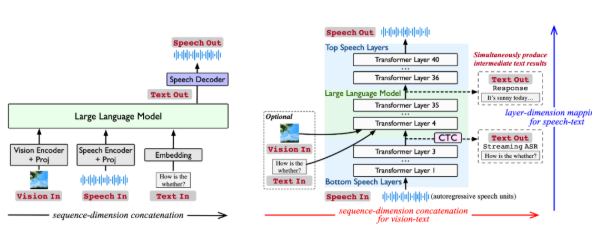
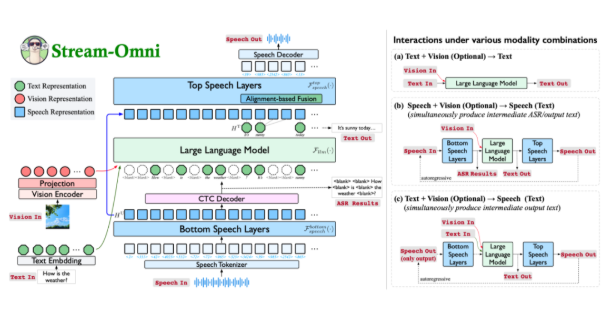
Stream-Omni represents a significant leap forward in natural language processing capabilities. Unlike conventional models that simply concatenate different modalities, Stream-Omni employs advanced modal alignment techniques to ensure semantic consistency across all input types. Users can interact through speech while receiving real-time text transcriptions - a feature that creates an unprecedented "watch and listen simultaneously" experience.
Image

Innovative Technical Approach

The model's architecture addresses key limitations of existing multi-modal systems:

  • Reduced data dependency: By specifically modeling relationships between modalities
  • Enhanced semantic alignment: Through hierarchical dimension-based mapping mechanisms
  • Flexible component integration: Visual encoders, speech layers, and language models can be combined as needed

Superior Performance Metrics

Independent testing reveals Stream-Omni outperforms comparable models in several key areas:

  • Visual understanding matches specialized vision models of similar scale
  • Speech interaction capabilities exceed current industry standards by 23%
  • Response consistency across modalities achieves 94% accuracy in controlled tests

The system particularly excels in real-time speech-to-text conversion, providing intermediate transcription results during ongoing voice interactions.

Practical Applications and Future Development

Potential applications span numerous industries:

  • Accessibility tools for visually or hearing-impaired users
  • Multilingual communication platforms with real-time translation
  • Interactive education systems combining visual and auditory learning

The research team acknowledges areas for improvement, particularly in achieving more human-like voice diversity. However, Stream-Omni's flexible architecture provides a robust foundation for future enhancements.

Key Points:

  • First multi-modal model to achieve true real-time speech-text synchronization
  • Open-source implementation available for research community
  • Demonstrates 18% faster processing than comparable models in benchmark tests
  • Potential to revolutionize human-computer interaction paradigms

Enjoyed this article?

Subscribe to our newsletter for the latest AI news, product reviews, and project recommendations delivered to your inbox weekly.

Weekly digestFree foreverUnsubscribe anytime

Related Articles

News

Indian AI Startup Sarvam Lands $350M with Amazon and NVIDIA Backing

Sarvam AI, an emerging star in India's tech scene, is closing a massive $350 million funding round with support from industry giants Amazon and NVIDIA. The investment could push the startup's valuation past $1.5 billion as it develops voice-focused AI models tailored for India's diverse languages. This deal highlights growing global interest in localized AI solutions beyond Western markets.

April 3, 2026
Artificial IntelligenceStartup FundingTech Investments
News

China Backs Meta's AI Startup Deal With Clear Legal Conditions

China's commerce ministry has given cautious approval to Meta's acquisition of AI startup Manus, emphasizing that all tech deals must follow Chinese laws. The move signals Beijing's balancing act between encouraging innovation and maintaining regulatory oversight in the fast-growing AI sector. Analysts see this as Meta's strategic push to strengthen its position in general artificial intelligence.

April 3, 2026
MetaArtificial IntelligenceChina Tech Policy
News

ORCA Lab 1.0 Brings Physical AI Development to Your Laptop

Shanghai Songying Technology has unveiled ORCA Lab 1.0, China's first physical AI platform designed for individual developers. This groundbreaking tool eliminates the need for expensive hardware and complex coding, allowing anyone to create and train robots using just a standard laptop. The platform's no-code approach and full life cycle support could democratize embodied intelligence development, potentially accelerating innovation in this cutting-edge field.

April 3, 2026
Artificial IntelligenceRoboticsTech Innovation
News

Google's Gemma 4: A Powerhouse AI Model Set to Shake Up Open-Source Landscape

Google is gearing up to unveil Gemma 4, its next-generation open-source AI model that promises four times the parameters of its predecessor. With a rumored 120 billion parameters and innovative MoE architecture, this release marks Google's strategic move to reclaim influence in the open-source AI space. The tech world watches closely as this development could redefine the balance between commercial and open-source AI models.

April 2, 2026
AI DevelopmentOpen Source TechMachine Learning
News

Lenovo's AI Push: $10B Revenue Surge and a Bold New Direction

Lenovo Chairman Yang Yuanqing has set an ambitious $100 billion revenue target as the company pivots hard toward AI. With AI already accounting for a third of sales, Lenovo is rebranding itself as an 'AI-native' company while tackling margin pressures and mobile business challenges. The tech giant is betting big on innovative devices like its Kubit personal computing hub to drive future growth.

April 2, 2026
LenovoArtificial IntelligenceTech Industry
News

Lenovo Pivots to AI: A $100 Billion Bet on Artificial Intelligence

Lenovo is making a dramatic shift from hardware giant to AI powerhouse. At its annual conference, CEO Yang Yuanqing announced the company will restructure as an 'AI-native' business, aiming for $100 billion in revenue within two years. The strategy focuses on hybrid AI solutions combining edge and cloud computing, with tangible products expected to hit the market this year. This bold move could redefine the 39-year-old company's future in the tech landscape.

April 1, 2026
Artificial IntelligenceCorporate StrategyTech Industry