
Seekr: A Compact AI Device Transforming Lives of the Visually Impaired

Seekr: A Compact AI Device Transforming Lives of the Visually Impaired

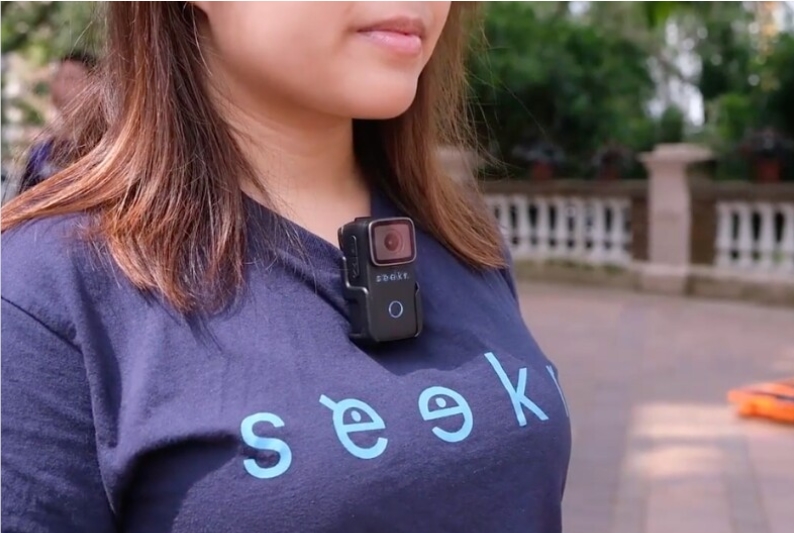
In a significant leap forward for assistive technology, Hong Kong startup Vidi Labs has launched Seekr, a groundbreaking device designed to enhance the lives of visually impaired individuals. This innovative tool, which is no larger than a matchbox, is being hailed as a pair of "smart eyes" that can speak, providing users with essential information about their surroundings.

The Inspiration Behind Seekr

The idea for Seekr was born during the COVID-19 pandemic in 2020, when founder Turzo Bose witnessed his visually impaired grandfather's struggles due to social distancing restrictions. Unable to receive live descriptions from family and friends, Bose was motivated to create a device that would allow his grandfather—and others like him—to better understand the world around them.
image

Features and Functionality

Seekr is equipped with a depth-sensing camera, a microprocessor, a battery, and a Bluetooth module, all working together to deliver real-time voice descriptions. Users can connect the device to a smartphone app and Bluetooth headphones to access four distinct scene modes:

  1. Scene Mode: Provides descriptions of the immediate environment, such as "There are two people sitting on a bench in front of you."
  2. Depth Mode: Guides users in locating specific objects by providing precise directions.
  3. Supermarket Mode: Identifies various products, offering descriptions like "This is bread" or "This is an apple."
  4. Text Mode: Reads out text from signs, menus, and packaging, making it easier for users to navigate daily tasks. For users with residual vision, it may even be possible to utilize just the smartphone app and camera, making Seekr a versatile tool accessible for the elderly as well.

Recognition and Pricing

Seekr has already received the CES 2025 Innovation Award, underscoring its impact and potential in the field of assistive technology. The device is priced at approximately $770, which includes a one-year subscription to the accompanying app. This pricing places Seekr within reach for many individuals and families seeking to enhance the quality of life for visually impaired loved ones.

A Bridge to the World

The introduction of Seekr represents more than just a technological advancement; it serves as a bridge connecting visually impaired individuals to the world around them. The compact size of the device belies its profound impact, providing a sense of independence and connection that many may take for granted.

In conclusion, the warmth of technology can be seen in Seekr's mission to empower its users. This small but mighty device holds the potential to revolutionize the daily experiences of the visually impaired community, illustrating how innovation can meet a heartfelt need.

Key Points

  1. Seekr is a compact AI device designed for visually impaired individuals.
  2. It offers real-time voice descriptions through four distinct scene modes.
  3. The device has won the CES 2025 Innovation Award and is priced at approximately $770.

Enjoyed this article?

Subscribe to our newsletter for the latest AI news, product reviews, and project recommendations delivered to your inbox weekly.

Weekly digestFree foreverUnsubscribe anytime

Related Articles

News

Survivalist Tests AI Limits in Freezing Snow Challenge

Film Hurricane founder Tim Pan is pushing boundaries again with an extreme survival challenge. Starting January 23rd, he'll brave -30°C temperatures in Northeast China for 100 hours armed only with paper, pencil, and AI image recognition technology. Supplies will come solely from drawings the AI can identify—a concept sparking both excitement and skepticism online. This follows Tim's recent uninhabited island survival feat that drew over 40 million viewers.

January 22, 2026
extreme survivalAI technologywinter challenge
News

AI Funding Frenzy Hits $150 Billion Amid Bubble Fears

AI startups have shattered funding records with $150 billion raised this year, but the staggering numbers are fueling concerns about overheating. While companies build financial 'fortresses' to weather uncertainty, analysts warn capital concentration could make markets fragile. Yet innovation continues unabated—experts predict survival will favor truly disruptive players as the industry likely consolidates.

December 29, 2025
AI investmentstartup fundingtech bubble
News

Unitree's Avatar System Brings Sci-Fi Robot Control to Life

Unitree Robotics has unveiled its groundbreaking Embodied Avatar system, allowing users to remotely control humanoid robots with near-instant precision. By combining motion capture with advanced AI, operators can make robots perform complex actions like martial arts or delicate manipulations from miles away. The technology promises applications ranging from industrial inspections to remote medical care, though questions about data security remain.

November 7, 2025
roboticstelepresenceAI
Google's AI Helps Blind Users Explore Streets Virtually
News

Google's AI Helps Blind Users Explore Streets Virtually

Google has developed StreetReaderAI, a multimodal AI system enabling blind and low-vision users to navigate Google Street View through natural language interactions. The prototype combines computer vision, GIS, and LLMs to provide real-time audio descriptions of surroundings.

October 31, 2025
Assistive TechnologyGoogle AIAccessibility Innovation
Top 10 Engineering Breakthroughs of 2025 Unveiled
News

Top 10 Engineering Breakthroughs of 2025 Unveiled

The Chinese Academy of Engineering has announced the Top Ten Engineering Achievements of 2025, highlighting global innovations in AI, space exploration, and sustainable technology. Notable inclusions are DeepSeek's open-source LLM and NVIDIA's Blackwell GPU architecture.

October 13, 2025
engineeringAIinnovation
Beijing Team Unveils World's First Humanoid Robot 3D Vision System
News

Beijing Team Unveils World's First Humanoid Robot 3D Vision System

A research team in Beijing has developed the world's first humanoid robot 3D vision system called 'Humanoid Occupancy.' This breakthrough technology uses semantic occupancy representation to provide detailed environmental modeling, overcoming previous limitations in robot perception. The system integrates multiple sensors and addresses industry challenges in data scarcity, potentially revolutionizing applications in household services, industrial manufacturing, and healthcare.

August 5, 2025
roboticsAIcomputer vision