

NVIDIA and Tsinghua Unveil Gamma-World: A Game-Changer in Multi-Agent Simulation
NVIDIA and Tsinghua University Break New Ground in Virtual Collaboration
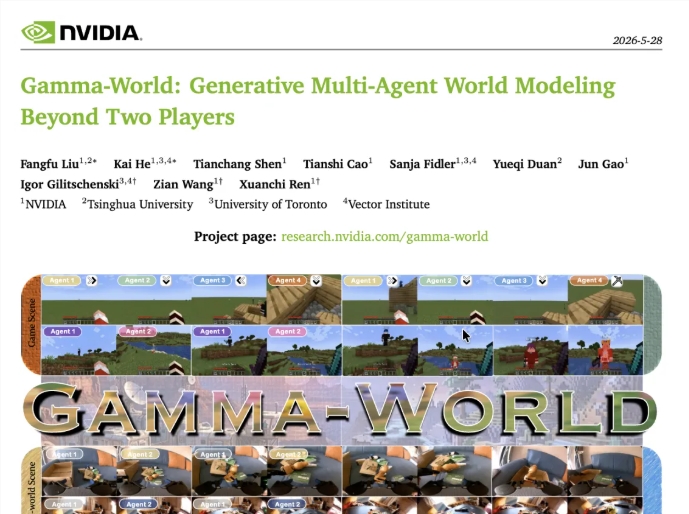
In a significant leap forward for virtual simulation technology, NVIDIA has partnered with Tsinghua University, the University of Toronto, and the Vector Institute to develop Gamma-World (γ-World). This breakthrough solution addresses the growing demand for more sophisticated multi-agent virtual environments where multiple participants can interact simultaneously.
The Challenge of Multi-Agent Simulation
Traditional virtual world models have primarily focused on single-agent scenarios, struggling to handle the complexity when multiple players operate in the same space. "Imagine trying to coordinate a team of robots or avatars where each one needs to perceive and react to others in real time," explains Dr. Li Wei from Tsinghua's AI lab. "That's the challenge Gamma-World was designed to solve."
Innovative Solutions for Complex Problems
Gamma-World introduces two groundbreaking approaches:
Simplex Rotary Agent Encoding: This clever geometric solution positions all players at equal distances on a simplex structure, ensuring fair representation without additional computational overhead. The team discovered this approach allows systems trained with just two agents to seamlessly handle four or more participants.
Sparse Hub Attention Mechanism: By replacing direct agent-to-agent communication with centralized hub tokens, the system achieves linear computational scaling rather than the quadratic growth that plagued previous attempts. "It's like switching from everyone talking at once to having a skilled moderator," one researcher analogized.
Real-World Performance and Applications
Initial testing in Minecraft environments demonstrated Gamma-World's superiority, showing 40% better results in video quality metrics while maintaining smooth 24FPS performance. But the implications extend far beyond gaming:
- Medical robotics: Enabling precise coordination between multiple surgical arms
- Industrial automation: Optimizing fleets of warehouse robots
- Autonomous vehicles: Creating more realistic traffic simulations
"What excites us most," shares NVIDIA's project lead, "is seeing how quickly these virtual advancements translate to physical world applications. Our early tests with dual-arm robots were remarkably successful."
The Future of Collaborative AI
The Gamma-World team employed an innovative three-stage training approach using teacher-student models, allowing complex simulations to run with just four computational steps. This breakthrough opens doors for more accessible, scalable multi-agent systems that could transform how we develop and test AI collaborations.
As virtual environments grow increasingly complex, solutions like Gamma-World provide the foundation for next-generation simulations where dozens - or even hundreds - of intelligent agents can interact seamlessly, bringing us closer to truly collaborative artificial intelligence.
Key Points
- Geometric encoding ensures fair representation of all agents
- Hub-based communication dramatically reduces computational costs
- 40% improvement in video quality metrics compared to existing solutions
- Real-time performance at 24FPS enables practical applications
- Successful adaptation from virtual to physical robotics