
MLX-LM Joins Hugging Face to Supercharge Apple Silicon AI

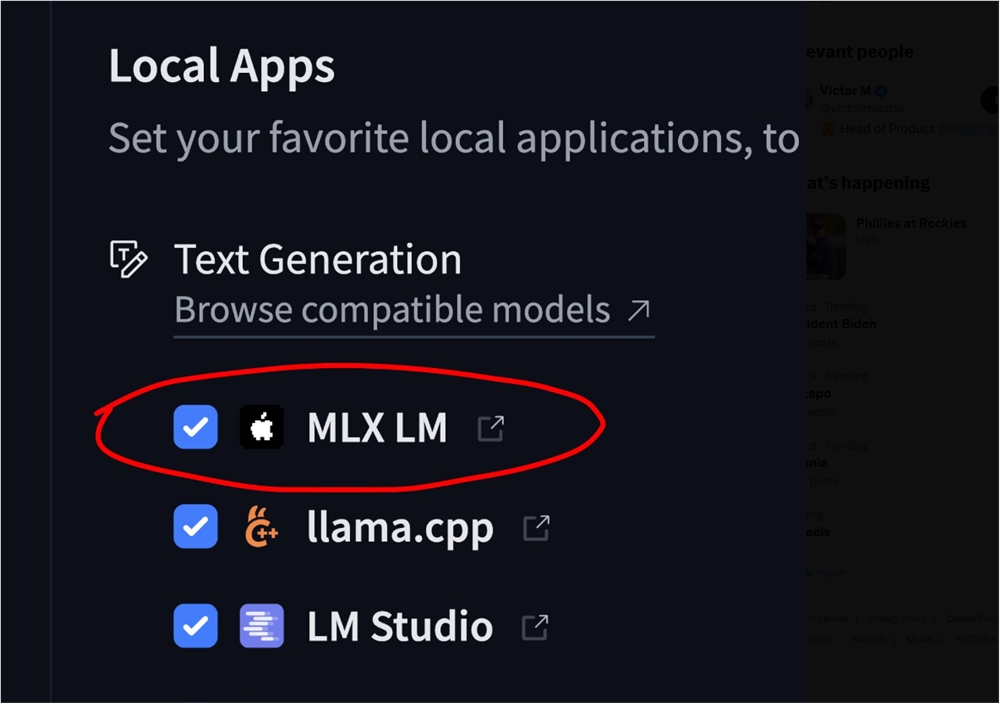
In a significant advancement for AI development on Apple devices, the MLX-LM framework has been fully integrated into the Hugging Face platform. This breakthrough allows developers using M1 through M4 chips to run more than 4,400 large language models locally at peak performance—eliminating both cloud reliance and tedious conversion processes.
Image

The integration marks a leap forward in localized AI development, offering researchers and engineers unprecedented efficiency. MLX, Apple's specialized machine learning framework, has been fine-tuned to harness the full potential of Apple Silicon's neural engine and Metal GPU capabilities. As its dedicated LLM component, MLX-LM brings this optimized performance directly to language model workflows.

Simplified Model Access Gone are the days of complex conversion steps. The Hugging Face integration means users can now pull models directly from the platform's extensive repository—no intermediary steps required. This streamlined approach cuts setup time dramatically while maintaining optimal performance.

Why This Matters For developers working on Macs, this update removes two major pain points: cloud dependency that introduces latency and privacy concerns, and the technical hurdles of model conversion. The direct compatibility means teams can prototype and deploy faster than ever before.

The framework's optimization for Apple's hardware architecture promises significant speed advantages over generic solutions. Early benchmarks show particularly strong performance gains in transformer-based models commonly used for natural language processing tasks.

Available models can be browsed at: Hugging Face MLX Library

Key Points

  1. Direct Hugging Face integration eliminates model conversion needs
  2. Over 4,400 LLMs now run natively on M-series chips
  3. Full utilization of Apple Silicon's neural engine capabilities
  4. Significant performance gains for local AI development
  5. Enhanced privacy by reducing cloud dependency

Enjoyed this article?

Subscribe to our newsletter for the latest AI news, product reviews, and project recommendations delivered to your inbox weekly.

Weekly digestFree foreverUnsubscribe anytime

Related Articles

Google's Gemini 3.1 Flash-Lite: Faster, Smarter, But Pricier
News

Google's Gemini 3.1 Flash-Lite: Faster, Smarter, But Pricier

Google DeepMind unveils Gemini 3.1 Flash-Lite, boasting impressive speed and intelligence gains over its predecessor. While processing over 360 tokens per second with quick response times, the model shines in complex tasks like scientific reasoning. However, these improvements come at a cost - pricing has nearly tripled, signaling a shift in the AI market towards premium performance.

March 4, 2026
AI DevelopmentGoogle DeepMindMachine Learning
News

Apple's M4 Chip Breakthrough Turns Mac Minis Into AI Powerhouses

In a surprising twist, engineers have unlocked hidden potential in Apple's M4 chips that could revolutionize AI development. By bypassing traditional limitations, researchers discovered Mac minis can now efficiently train complex AI models—achieving energy efficiency up to 80 times better than high-end GPUs. This breakthrough could dramatically lower the barrier to entry for AI innovation.

March 9, 2026
Apple SiliconAI HardwareEdge Computing
Apple's M5 chips redefine laptop power with groundbreaking AI and battery life
News

Apple's M5 chips redefine laptop power with groundbreaking AI and battery life

Apple has unveiled its next-generation M5 Pro and M5 Max chips, delivering revolutionary AI performance and unprecedented battery efficiency. The new MacBook Pro models can run for a full day on a single charge while offering four times the AI processing power of previous generations. Alongside these powerhouse machines, Apple also introduced more affordable M5-powered MacBook Air models and upgraded Studio Displays with stunning 5K resolution.

March 5, 2026
Apple SiliconAI ComputingLaptop Technology
OpenClaw Makes Social Media Debut, Sparking Buzz Among China's AI Giants
News

OpenClaw Makes Social Media Debut, Sparking Buzz Among China's AI Giants

The open-source AI project OpenClaw has officially launched its Weibo account, quickly drawing attention from major Chinese tech players like Zhipu and Moonshot. This US-based initiative is reshaping how industrial AI operates in China, moving beyond simple chatbots to tackle complex business challenges. Its rapid rise on GitHub and prominence at MWC2026 signal a new phase in open-source AI development.

March 4, 2026
OpenClawAI DevelopmentTech Innovation
DeepSeek V4 Lite: The Compact AI Model Making Waves
News

DeepSeek V4 Lite: The Compact AI Model Making Waves

DeepSeek V4 Lite, a surprisingly powerful AI model with just 200 billion parameters, is turning heads in the tech community. Originally launched in February with strong long-context processing capabilities, recent updates have dramatically improved its performance. Developers report it now rivals top international models like Anthropic Claude 3.5 Sonnet in logic, programming, and aesthetics. This unexpected leap forward has sparked excitement about what its full version might achieve.

March 3, 2026
Artificial IntelligenceMachine LearningDeepSeek
Sakana AI's Tiny Plugin Could Revolutionize How AI Handles Massive Documents
News

Sakana AI's Tiny Plugin Could Revolutionize How AI Handles Massive Documents

Tokyo-based Sakana AI has unveiled groundbreaking technologies that could solve large language models' notorious 'memory anxiety.' Their Text-to-LoRA and Doc-to-LoRA systems enable AI to digest lengthy documents in under a second, shrinking memory requirements from gigabytes to mere megabytes. This breakthrough promises to make customizing AI models dramatically cheaper and more accessible.

February 28, 2026
AI InnovationMachine LearningNatural Language Processing