
Meta Unveils SPIRIT LM: An AI Model for Emotional Expression

Meta Unveils SPIRIT LM: An AI Model for Emotional Expression

Meta AI has announced the open-source release of SPIRIT LM, a foundational multimodal language model designed to blend text and speech seamlessly. This development opens new avenues for applications involving both audio and textual data.

Overview of SPIRIT LM

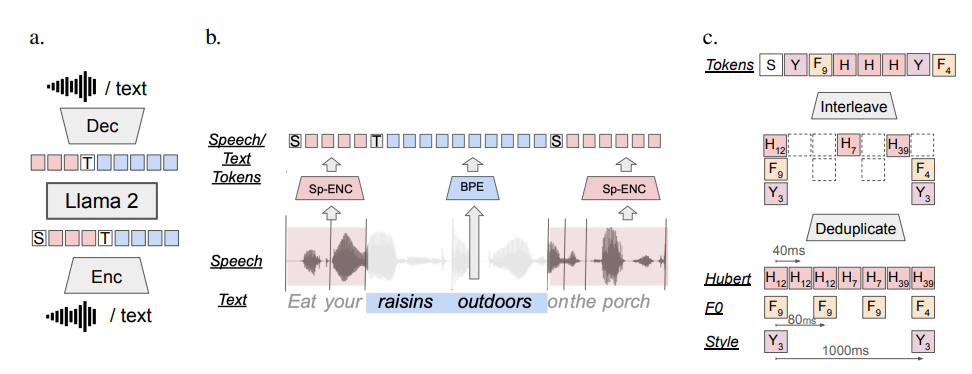
SPIRIT LM is built upon a pre-trained text model comprising 7 billion parameters. This model has been enhanced through continuous training on both text and speech units, allowing it to understand and generate text akin to other large text models. Notably, it can also handle speech, enabling it to mix text and speech effectively for various applications. For example, SPIRIT LM can be utilized for:

  • Speech Recognition: Converting spoken language into text.
  • Speech Synthesis: Transforming written text into spoken language.
  • Speech Classification: Assessing the emotional tone conveyed in speech. image
Emotional Expression Capabilities

One of SPIRIT LM's standout features is its ability to convey emotional expression. The model can discern and generate a range of speech tones and styles, resulting in a voice that sounds more human and emotive. This advancement means that the output from SPIRIT LM resembles real human speech, moving away from the typical cold and robotic tones found in many AI systems.

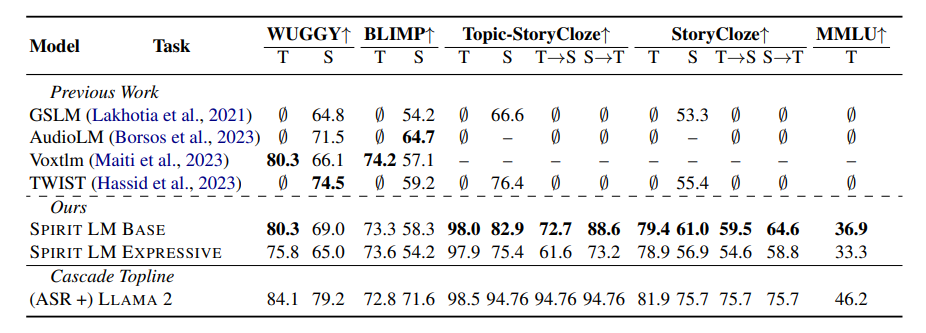
To optimize the emotional expressiveness of the AI, Meta's researchers have created two versions of SPIRIT LM:

  • Base Version (BASE): Focuses primarily on the phonetic aspects of speech.
  • Expressive Version (EXPRESSIVE): Incorporates phonetic information along with tone and style, enabling a richer and more vivid vocal output. image
Training Methodology

The development of SPIRIT LM leverages Meta's powerful LLAMA2 text model. Researchers employed a unique interleaved training approach, feeding a large dataset consisting of both text and speech. This method allows LLAMA2 to learn the patterns of text and speech simultaneously, crucial for achieving the model's multimodal capabilities.

Benchmarking Emotional Expression

To evaluate SPIRIT LM's proficiency in emotional expression, researchers established a new benchmark known as the Speech-Text Emotion Preservation Benchmark (STSP). This benchmark features various prompts that express differing emotions, assessing the model's ability to recognize and generate text and speech that accurately reflect those emotions. Preliminary results indicate that the Expressive Version of SPIRIT LM excels in emotion retention, positioning it as the first AI model capable of achieving cross-modal emotion preservation.

Future Improvements

Despite its advancements, Meta's researchers acknowledge that SPIRIT LM has multiple areas for enhancement. For example, the model currently supports only English and will need to expand its language capabilities. Additionally, the model size is considered suboptimal, necessitating further growth to improve performance.

Conclusion

SPIRIT LM represents a significant breakthrough for Meta in the realm of artificial intelligence, heralding a future where AI can engage in emotionally expressive interactions. As developments progress, it is anticipated that SPIRIT LM will inspire innovative applications, enabling AI to converse in a more relatable and human-like manner. This evolution could facilitate more natural and friendly interactions between humans and AI systems.

For more information, visit the project page at SPIRIT LM Project and access the research paper here.

Key Points

  1. SPIRIT LM is an open-source multimodal language model from Meta AI.
  2. The model excels in emotional expression, simulating human-like speech.
  3. Two versions of SPIRIT LM focus on different aspects of speech.
  4. Future improvements include expanding language support and model size.

Enjoyed this article?

Subscribe to our newsletter for the latest AI news, product reviews, and project recommendations delivered to your inbox weekly.

Weekly digestFree foreverUnsubscribe anytime

Related Articles

Meta's AI Shopping Assistant Takes Aim at Retail Giants
News

Meta's AI Shopping Assistant Takes Aim at Retail Giants

Meta is quietly rolling out a new shopping feature in its AI assistant that could shake up online retail. The tool delivers personalized product recommendations complete with images, prices, and buying links - all tailored to your location and browsing history. While still in testing, this move signals Meta's ambition to compete directly with ChatGPT and Google in the battle for AI-powered commerce.

March 3, 2026
MetaAIAI CommercePersonalized Shopping
Meta's Pixio Rewrites the Rules: Simple Approach Beats Complex AI in 3D Vision
News

Meta's Pixio Rewrites the Rules: Simple Approach Beats Complex AI in 3D Vision

Meta AI's new Pixio model proves simplicity can outperform complexity in computer vision. By enhancing an older masking technique and training on diverse web images, Pixio achieves better 3D reconstruction than larger models—all while avoiding benchmark 'cheating.' The breakthrough suggests we might have overcomplicated visual AI.

December 29, 2025
ComputerVisionMetaAI3DReconstruction
Alibaba's Bai Ling Speech Model Now Speaks Your Language—And Your Emotions
News

Alibaba's Bai Ling Speech Model Now Speaks Your Language—And Your Emotions

Alibaba's Tongyi large model team has unveiled groundbreaking upgrades to its Bai Ling speech technology. With just three seconds of audio, these open-source models can now switch seamlessly between nine languages and eighteen dialects—from Mandarin to Cantonese, Japanese to English. Beyond multilingual capabilities, they capture emotional nuances like happiness and anger. Significant technical improvements include halved response delays and 93% accuracy even in noisy environments. Developers can now access these tools locally for customized applications.

December 15, 2025
Speech SynthesisAI InnovationMultilingual Technology
Meta Launches Code World Model, Advancing AI Programming
News

Meta Launches Code World Model, Advancing AI Programming

Meta has introduced the Code World Model (CWM), a large language model designed to enhance AI's code generation capabilities. Leveraging a 'world model' concept, CWM predicts instruction effects during coding, improving quality and reasoning. Trained on extensive Python and Bash data, it excels in benchmarks despite its smaller size.

September 25, 2025
AIProgrammingMetaAICodeGeneration
Meta Unveils Code World Model CWM: A 32B AI with Sandbox Reasoning
News

Meta Unveils Code World Model CWM: A 32B AI with Sandbox Reasoning

Meta has launched its advanced Code World Model (CWM), a 32B-parameter AI designed for deep code understanding and reasoning. Unlike traditional models, CWM operates in a sandbox environment to predict code outcomes before execution, reducing errors and enabling intelligent debugging. However, its high hardware demands require dual H100 GPUs and RDMA technology.

September 25, 2025
MetaAICodeGenerationAIInnovation
Meta AI Launches MobileLLM-R1: A Lightweight Edge AI Model
News

Meta AI Launches MobileLLM-R1: A Lightweight Edge AI Model

Meta AI has introduced MobileLLM-R1, a series of lightweight edge inference models with parameters ranging from 140M to 950M. Designed for efficiency in mathematical, coding, and scientific reasoning, these models achieve competitive performance while reducing training costs and resource requirements. The largest model, MobileLLM-R1-950M, outperforms larger models in benchmark tests despite using significantly fewer tokens.

September 16, 2025
MetaAIEdgeAILightweightModels