
Meta AI Unveils FBDetect for Enhanced Performance Monitoring

Meta AI Unveils FBDetect for Enhanced Performance Monitoring

In managing large-scale cloud infrastructures, even minor performance declines can lead to significant resource waste. At companies like Meta, a 0.005% slowdown in application performance may seem negligible; however, when operating millions of servers simultaneously, this small delay can accumulate into considerable inefficiencies across thousands of servers. Thus, the prompt identification and remediation of these subtle performance regressions is a substantial challenge for Meta.
image

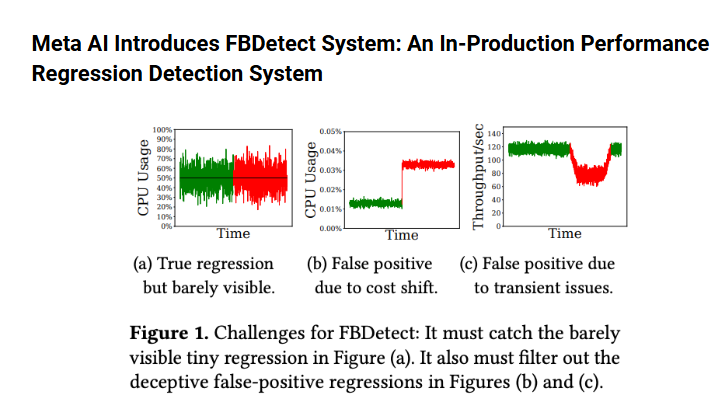
To address this issue, Meta AI has introduced FBDetect, a performance regression detection system tailored for production environments that is capable of capturing the smallest regressions, as low as 0.005%. FBDetect monitors approximately 800,000 time series, which encompass critical metrics such as throughput, latency, CPU, and memory usage across hundreds of services and millions of servers. Utilizing innovative techniques like stack trace sampling across entire server clusters, FBDetect can detect subtle performance differences at the subroutine level.
image

Focus on Subroutine-Level Analysis

FBDetect primarily targets subroutine-level performance analysis, effectively reducing the detection difficulty from a 0.05% application-level regression to a more manageable 5% subroutine-level change. This focused approach significantly minimizes noise, making it more practical for developers to track changes.

The core technology of FBDetect encompasses three main components:

  1. Variance Reduction: It reduces variance in performance data through subroutine-level regression detection, facilitating the identification of even minute regressions promptly.
  2. Stack Trace Sampling: The system conducts detailed stack trace sampling across the entire server cluster, accurately measuring the performance of each subroutine, akin to performance analysis in a large-scale environment.
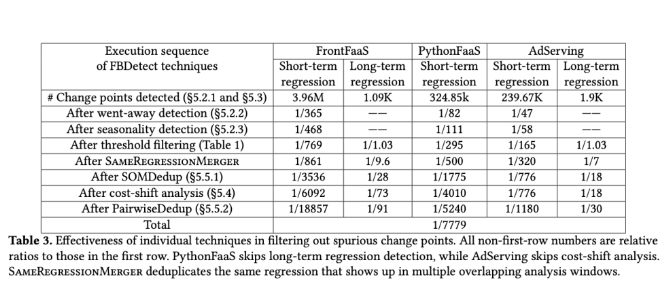
  3. Root Cause Analysis: For every detected regression, FBDetect performs root cause analysis to ascertain if the regression stems from transient issues, cost changes, or actual code modifications. After seven years of real-world production testing, FBDetect demonstrates robust interference resistance, effectively filtering out false regression signals. The introduction of this system not only significantly reduces the number of incidents that developers need to investigate but also enhances the efficiency of Meta's infrastructure. By identifying minor regressions, FBDetect aids Meta in avoiding the waste of approximately 4,000 servers annually.

For large enterprises like Meta, which operate millions of servers, detecting performance regressions is critically important. FBDetect's advanced monitoring capabilities not only improve the detection rate of minor regressions but also equip developers with effective root cause analysis tools, facilitating the timely resolution of potential issues and promoting the efficient operation of the entire infrastructure.

For further details, you can access the research paper here: FBDetect Paper.

Key Points

  1. FBDetect can monitor subtle performance regressions, even as low as 0.005%, greatly enhancing detection precision.
  2. The system covers approximately 800,000 time series, involving multiple performance metrics, and can perform precise analysis in large-scale environments.
  3. After seven years of practical application, FBDetect helps Meta avoid the waste of approximately 4,000 servers annually, improving the overall efficiency of its infrastructure.

Enjoyed this article?

Subscribe to our newsletter for the latest AI news, product reviews, and project recommendations delivered to your inbox weekly.

Weekly digestFree foreverUnsubscribe anytime

Related Articles

Microsoft's MAI-Image-2 Breaks Into Global Top 3 for AI Image Generation
News

Microsoft's MAI-Image-2 Breaks Into Global Top 3 for AI Image Generation

Microsoft has unveiled its powerful new MAI-Image-2 model, which now ranks among the world's top three text-to-image AI systems. The breakthrough technology solves the persistent problem of garbled text in AI-generated images while delivering stunning visual quality. Users can already test the model for free, with plans to integrate it into Microsoft's productivity tools soon.

March 20, 2026
AIMicrosoftimage-generation
News

Tech Titans Unite: $12.5M Boost for Open-Source Security

In a rare show of unity, Google, Microsoft, OpenAI and other tech giants have pooled $12.5 million to help the Linux Foundation tackle a growing problem - the flood of unreliable AI-generated security reports overwhelming open-source maintainers. The funding will support efforts to filter out these 'AI garbage reports' while protecting critical open-source infrastructure. This collaboration marks another step in the industry's push to establish shared security standards beyond competitive interests.

March 18, 2026
OpenSourceCybersecurityAI
Manus AI Brings 'My Computer' to Life with 20-Minute App Creation
News

Manus AI Brings 'My Computer' to Life with 20-Minute App Creation

Meta's AI platform Manus just made a game-changing leap from the cloud to your desktop. Their new 'My Computer' feature lets AI agents directly manage files, automate tasks, and even build apps in minutes - all while keeping your data secure with strict human oversight. This could transform how we interact with our devices, turning AI from a helper into a true digital colleague.

March 18, 2026
AIProductivity ToolsMeta
NVIDIA's NemoClaw Brings One-Click AI to OpenClaw Ecosystem
News

NVIDIA's NemoClaw Brings One-Click AI to OpenClaw Ecosystem

NVIDIA has unveiled NemoClaw, a game-changing toolkit that simplifies AI agent deployment for the OpenClaw platform. With just one command, users can now install powerful AI models like Nemotron and OpenShell runtime. The solution addresses critical privacy concerns with isolated sandboxes and hybrid model strategies while supporting everything from consumer devices to enterprise supercomputers. NVIDIA CEO Jensen Huang calls it the 'AI operating system' of our era.

March 17, 2026
AINVIDIAOpenClaw
Zhipu's GLM-5-Turbo: The AI Assistant That Won't Quit on You
News

Zhipu's GLM-5-Turbo: The AI Assistant That Won't Quit on You

Zhipu AI has unveiled GLM-5-Turbo, a powerful new model designed to tackle complex tasks without stalling. Unlike standard AI tools that might falter with lengthy processes, this upgrade focuses on four key improvements: reliable tool usage, breaking down complicated requests, understanding time-sensitive tasks, and handling heavy workloads efficiently. Early tests show it outperforms competitors in real-world business scenarios, with major tech companies already praising its accuracy and reliability.

March 17, 2026
AIZhipuProductivity
News

MiniMax Surpasses Baidu: China's AI Landscape Gets a Shake-Up

In a stunning market reversal, AI unicorn MiniMax has overtaken tech giant Baidu with a HK$382.6 billion valuation. The company's stock surged 22% amid strong financials showing 158.9% revenue growth, with 70% coming from international markets. This milestone signals shifting priorities in China's AI sector - from technical benchmarks to real-world profitability and global competitiveness.

March 11, 2026
AITechStocksMarketTrends