

Li Feifei's New Benchmark Shows AI Still Struggles with Real-World Interaction
AI's Spatial Intelligence Put to the Test
When you glance around a room, your brain effortlessly calculates distances, anticipates obstacles, and plans routes. For AI, this simple human ability remains astonishingly difficult. Stanford's Fei-Fei Li and her team have created ESI-Bench, a groundbreaking benchmark that finally measures how well AI systems understand and interact with physical space.
From Passive Observer to Active Participant
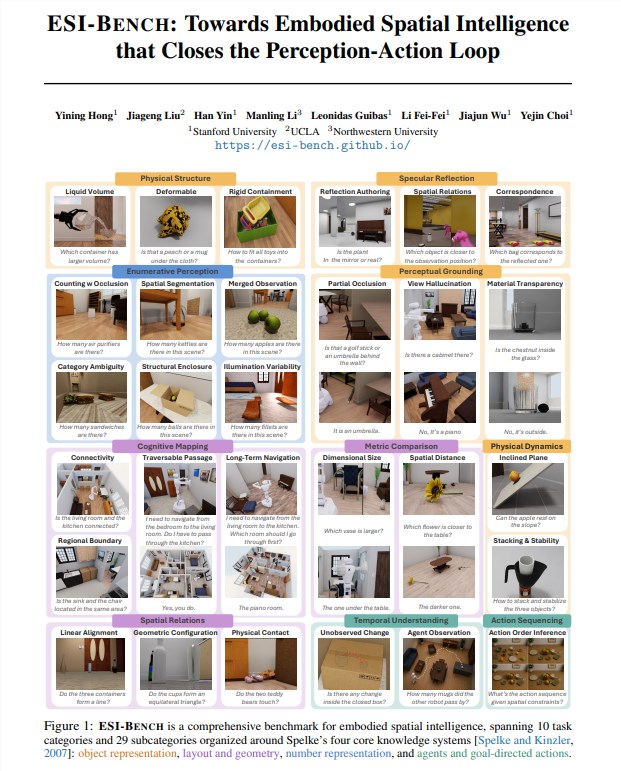
Traditional AI tests evaluate spatial reasoning using curated images—like showing a model several angles of a chair and asking "What is this?" ESI-Bench flips this approach. Here, the AI must actively explore virtual environments, deciding where to move, what to examine, and how to manipulate objects to solve problems.
Key innovations:
- Based on cognitive science principles of how infants learn spatial concepts
- Covers 3,081 tasks across 10 categories like object manipulation and navigation
- Built on the OmniGibson platform with realistic physics simulation
Three Painful Truths About Today's AI
Testing top models like GPT-5 and Gemini revealed unexpected weaknesses:
1. Seeing Isn't Doing
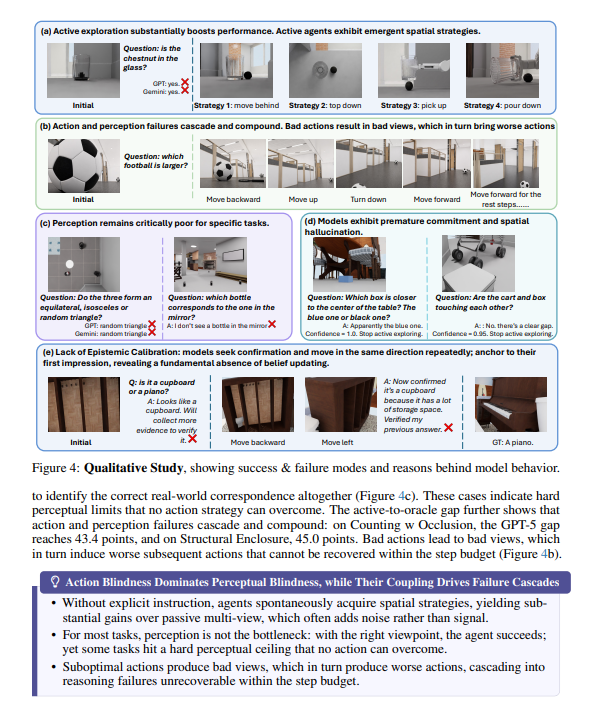
Give an AI the perfect camera angle, and it'll ace spatial questions. But ask it to find that viewpoint itself? Performance plummets. Models lack strategic thinking—they might bump into walls or examine irrelevant objects, creating a cascade of errors.
2. 3D Maps Can Lie
Researchers assumed 3D scene reconstructions would boost performance. Surprisingly, imperfections in these maps—like depth errors or missing objects—actually mislead AI more than simple 2D images. It's like navigating with a faulty GPS versus trusting your eyes.
3. The Confidence Trap
Humans know when they're guessing. Current AI doesn't. Models often stop exploring prematurely, then answer incorrectly with high certainty. This "metacognitive deficit" means AI can't assess whether it's seen enough to make reliable judgments.
What's Next for Embodied AI?
ESI-Bench isn't just a test—it's a roadmap. Future systems will need:
- Active exploration strategies (not just better vision)
- Error-resistant reasoning with incomplete data
- Self-doubt mechanisms to recognize knowledge gaps
As Li's team notes, true spatial intelligence requires more than bigger datasets. AI needs to learn the art of physical discovery—just like a curious child exploring their world.
Key Points:
- ESI-Bench evaluates AI's ability to actively interact with environments
- Top models struggle with autonomous exploration and 3D perception
- Lack of "knowing what you don't know" remains a major hurdle
- Future AI may need metacognitive abilities for real-world tasks