

Hong Kong researchers teach AI agents to stop hoarding useless skills
AI Agents Get Smarter About Skill Management
Artificial intelligence has moved beyond simple chatbots to complex agents that can complete multi-step tasks. But as these digital helpers take on more responsibilities, researchers have noticed a worrying trend - they're becoming digital packrats, accumulating skills they don't need while struggling to manage them effectively.
The SLIM Solution
The Chinese University of Hong Kong team tackled this problem head-on with their SLIM framework. Imagine teaching a child when to use a calculator versus doing math in their head - that's essentially what SLIM does for AI agents. It creates a dynamic system where skills aren't just added forever, but carefully evaluated for their real-world usefulness.
"Traditional approaches either led to skill overload or forced everything into the model's parameters," explains Dr. Zhang, lead researcher on the project. "SLIM gives agents the ability to be selective, just like humans are when we decide which skills to maintain through practice and which to let fade."
How SLIM Works
The framework operates through an elegant three-step cycle:
- Skill Retrieval: The system pulls relevant skills for the current task
- Performance Testing: Using the GRPO algorithm, it evaluates how well these skills contribute
- Lifecycle Decision: Each skill gets regularly audited through a "leave-one-skill-out" test
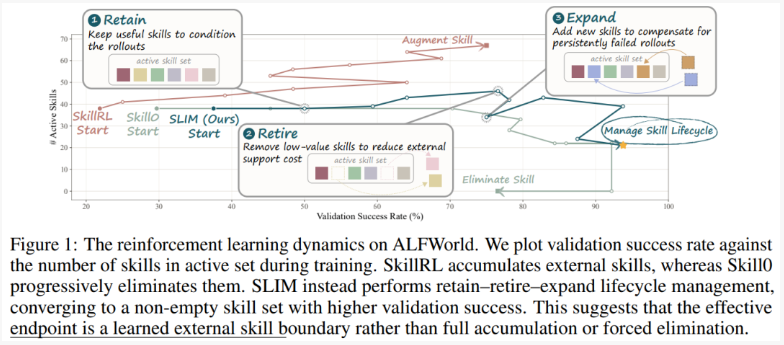
Skills that prove essential get retained. Those that consistently underperform get retired. And when the agent keeps failing at certain tasks, SLIM helps it develop new capabilities to fill the gaps.
Real-World Results
The numbers speak for themselves. In home environment simulations, SLIM-powered agents achieved an 87.5% success rate compared to 75% for traditional methods. For search-related tasks, the framework showed particular strength in helping models internalize effective search strategies rather than constantly relying on external tools.
"What excites me most," says AI researcher Dr. Chen from Stanford, "is how SLIM blurs the line between internal and external capabilities. It's teaching agents to develop what we might call 'meta-skills' - knowing when to use which abilities, and when to let them go."
The Future of AI Capabilities
As AI systems take on more complex roles in both digital and physical spaces, frameworks like SLIM could prevent the equivalent of digital hoarding disorder. The Hong Kong team's approach suggests that sometimes, less really is more - especially when it comes to skill management in artificial intelligence.
Key Points:
- SLIM helps AI agents dynamically manage external skills
- Uses a unique "leave-one-skill-out" testing method
- Outperforms traditional approaches by 7.1% on average
- Particularly effective in home robotics and search tasks
- Represents a shift toward more selective, thoughtful AI capability development