
Google's Gemini Split-Screen is Taking Over Android Devices!

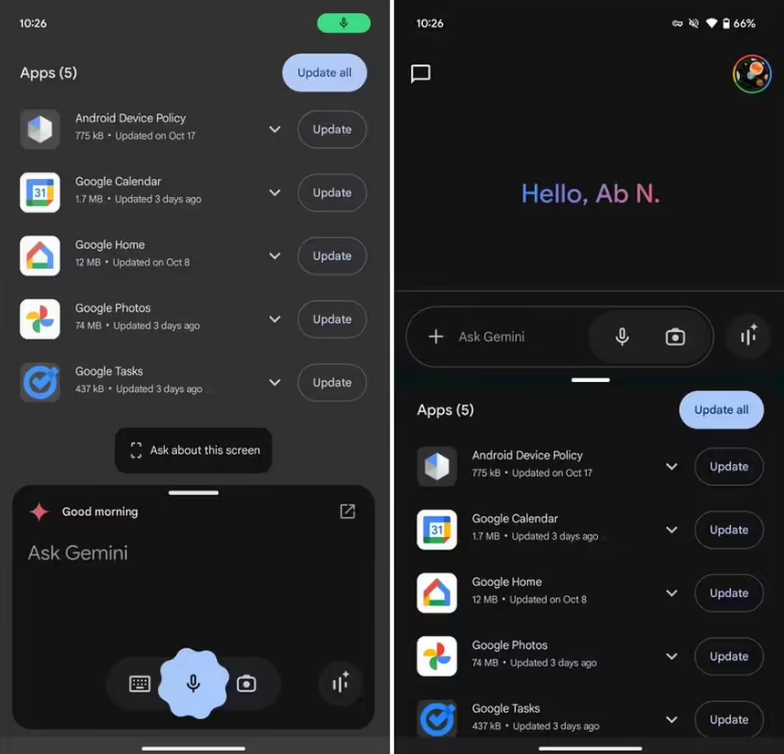
Google's eminiAI assistant is on a roll, and it's not tiptoeing—it's stomping onto more devices than ever. Remember when only the Samsung Galaxy Z Fold6 had the honor of hosting this slick split-screen functionality? Those days are gone. Now, Android tablets, foldables, and Google's own Pixel lines are joining the Gemini revolution.

What's the Big Deal?

Google is pushing its split-screen feature on a massive scale, giving a whole new meaning to multitasking. The feature was initially limited to the amsung Galaxy Z Fold6running One UI 6.1.1. But now, brace yourselves—it's coming to a whole parade of devices, including:

  • Samsung Galaxy Tab series tablets
  • Early Galaxy Z Fold models
  • Google's Pixel Tablet
  • The upcoming, highly anticipated Pixel 9 Pro Fold Yep, that’s a lot of screens! More users, more devices, and more Gemini.
image

Smarter Than Ever!

But wait, there's more! This update isn’t just about expanding access—Google has thrown in some shiny new smarter interface controls. Gemini’s chat interface now sports a central handle at the top, making it ridiculously easy to drag and split your screen with other apps. Whether you want your windows side-by-side or stacked in a top-bottom view, Gemini's got your back.

No more fumbling around like an amateur! With these new controls, you can multitask like a pro—call upon the AI assistant while scrolling through your latest obsession or researching your next big project. Efficiency? Through the roof.

Google’s Power Move

This rollout isn’t just a nice-to-have—it’s part of Google’s bigger plan to dominate the AI assistant game. By embedding Gemini deeper into Android’s very veins, Google is transforming how we use our devices. No longer just a phone or a tablet, your device can now juggle all your tasks with AI-powered finesse. Whether you're swiping through social media or managing work emails, Gemini's there to make your life easier.

It’s more than a tech feature—it’s a paradigm shift. Google is pioneering new ways for us to interact with technology, and you better believe other companies are watching closely.

From Niche to Norm

Remember when this feature was just a cute little experiment on one device? Well, that's ancient history. This broader rollout means that more users than ever will get to experience the convenience of Gemini. It’s a clear signal that Google isn’t just dabbling in AI—it’s setting the pace.

This widespread deployment is just the beginning. With the number of supported devices growing, expect more people to jump on this AI-powered bandwagon. Google's relentless innovation in the AI field is starting to bear serious fruit, and spoiler alert: it’s going to change how you think about multitasking.

The Future Looks Split (in a Good Way)

What’s the takeaway? Google is dead-set on making AI-assisted multitasking the new normal. With Gemini’s expanded reach, users across various devices will enjoy a smoother, smarter, and more efficient way to handle their digital lives. If you haven’t experienced the magic of split-screen with AI, now’s your chance.

Get ready, because multitasking just evolved. And trust us—you’re going to love it.


Summary

  1. Google’s Gemini split-screen is no longer exclusive to the Samsung Galaxy Z Fold6—it’s rolling out to a bunch of Android tablets and foldables.

  2. New interface controls make multitasking easier than ever, with a drag-and-drop handle for flexible split-screen setups.

  3. Google’s accelerating its AI assistant ecosystem, making Gemini a key player in how we interact with mobile devices.

  4. This broader rollout means more users and devices will benefit from Gemini’s powerful multitasking features.

  5. It’s a clear sign that Google’s not just testing AI—it’s leading the charge in intelligent device interaction.

Enjoyed this article?

Subscribe to our newsletter for the latest AI news, product reviews, and project recommendations delivered to your inbox weekly.

Weekly digestFree foreverUnsubscribe anytime

Related Articles

NVIDIA's NemoClaw Brings One-Click AI to OpenClaw Ecosystem
News

NVIDIA's NemoClaw Brings One-Click AI to OpenClaw Ecosystem

NVIDIA has unveiled NemoClaw, a game-changing toolkit that simplifies AI agent deployment for the OpenClaw platform. With just one command, users can now install powerful AI models like Nemotron and OpenShell runtime. The solution addresses critical privacy concerns with isolated sandboxes and hybrid model strategies while supporting everything from consumer devices to enterprise supercomputers. NVIDIA CEO Jensen Huang calls it the 'AI operating system' of our era.

March 17, 2026
AINVIDIAOpenClaw
Zhipu's GLM-5-Turbo: The AI Assistant That Won't Quit on You
News

Zhipu's GLM-5-Turbo: The AI Assistant That Won't Quit on You

Zhipu AI has unveiled GLM-5-Turbo, a powerful new model designed to tackle complex tasks without stalling. Unlike standard AI tools that might falter with lengthy processes, this upgrade focuses on four key improvements: reliable tool usage, breaking down complicated requests, understanding time-sensitive tasks, and handling heavy workloads efficiently. Early tests show it outperforms competitors in real-world business scenarios, with major tech companies already praising its accuracy and reliability.

March 17, 2026
AIZhipuProductivity
News

MiniMax Surpasses Baidu: China's AI Landscape Gets a Shake-Up

In a stunning market reversal, AI unicorn MiniMax has overtaken tech giant Baidu with a HK$382.6 billion valuation. The company's stock surged 22% amid strong financials showing 158.9% revenue growth, with 70% coming from international markets. This milestone signals shifting priorities in China's AI sector - from technical benchmarks to real-world profitability and global competitiveness.

March 11, 2026
AITechStocksMarketTrends
Xie Saining's Team Unveils Solaris: A Breakthrough in Multi-User Video AI
News

Xie Saining's Team Unveils Solaris: A Breakthrough in Multi-User Video AI

Xie Saining's research team has launched Solaris, the world's first multi-user video world model, powered by Kunlun Wanzhi's Matrix-Game2.0. This innovative technology enhances player interaction in environments like Minecraft, outperforming previous solutions. The release coincides with a major funding milestone for Xie's AI company, AMI, highlighting the growing importance of world models in advancing artificial general intelligence.

March 11, 2026
AIMachine LearningVirtual Worlds
ChatGPT Now Recognizes Songs Like Shazam - Here's How It Works
News

ChatGPT Now Recognizes Songs Like Shazam - Here's How It Works

OpenAI has teamed up with Shazam to bring music recognition directly into ChatGPT. No more switching apps when you hear that catchy tune - just ask ChatGPT what's playing and get instant results. The integration lets users identify songs through simple voice or text commands, complete with artist info and preview clips. It's like having a music-savvy friend in your chat.

March 10, 2026
OpenAIChatGPTShazam
GPT-5.4 Arrives With Mind-Reading AI and Million-Token Memory
News

GPT-5.4 Arrives With Mind-Reading AI and Million-Token Memory

OpenAI's latest model, GPT-5.4, introduces revolutionary features that bring us closer to truly intelligent digital assistants. The new Thinking mode lets users peer into the AI's reasoning process, while million-token memory enables handling massive documents. Perhaps most impressive are its native computer operation abilities - this AI doesn't just talk, it can actually work across your applications.

March 6, 2026
AIOpenAIGPT