

Google's AI Just Cracked Two Math Mysteries That Stumped Experts for Decades
Google's Math-Busting AI Makes Historic Breakthrough
In a development that's sending ripples through academic circles, Google DeepMind's AlphaProof Nexus has solved two mathematical problems that have resisted solution since the 1960s. This isn't just another AI milestone - it's a demonstration of machine intelligence tackling abstract reasoning at levels previously thought impossible.
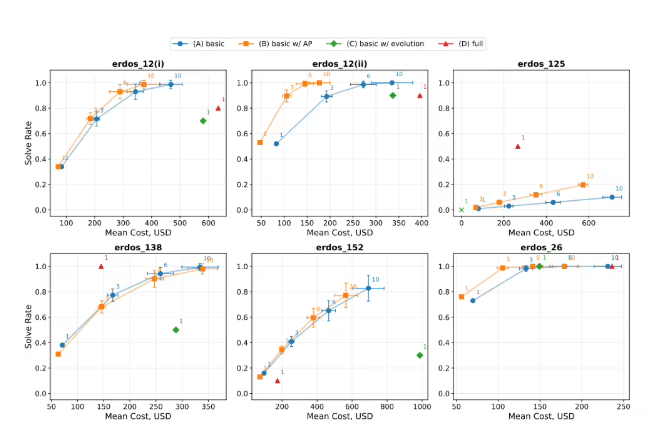
How Four AI Minds Outsmarted Decades of Human Effort
The secret lies in AlphaProof Nexus's unique architecture. Imagine four specialized mathematicians working together:
- The first handles basic problem interpretation
- The second generates potential solution fragments
- The third evolves these ideas through trial and error
- The fourth acts as an editor, evaluating and refining the best approaches
"What's remarkable," notes the research team, "is how these components create something greater than their sum. The system solved problems we didn't specifically program it to address."
From Erdős to Hilbert: An AI Problem-Solving Spree
During testing, the system:
- Cracked 9 of 353 open Erdős problems
- Proved 44 conjectures from the Online Encyclopedia of Integer Sequences
- Solved a 15-year-old Hilbert function challenge
- Advanced work in convex optimization
Perhaps most surprising? The computational cost. Solving a complex proof might cost just hundreds of dollars - less than many academic research budgets.
The Compiler Feedback Advantage
Researchers discovered an unexpected benefit: the system's interaction with the Lean compiler creates a learning loop. Even basic versions of the AI could solve problems when anchored by this feedback mechanism, suggesting future systems might achieve similar results with even leaner architectures.
Key Points:
- Historic achievement: Solved 56-year-old mathematical puzzles
- Novel architecture: Four-tiered AI system outperforms single-model approaches
- Cost-effective: Complex proofs at modest computational expense
- Broader implications: Demonstrates AI's potential in abstract reasoning domains