ByteDance's Trae IDE Under Fire for Data Privacy Issues

ByteDance's Trae IDE Faces Data Privacy Scrutiny

ByteDance's Trae IDE, an AI-powered programming environment, has come under fire after a developer publicly disclosed that the tool continues to upload user data to ByteDance servers even when telemetry features are disabled. The revelation has sparked widespread criticism in the developer community.

The Controversy Unveiled

A detailed report posted on GitHub revealed that Trae IDE makes approximately 500 network requests within seven minutes, uploading a total of 26MB of data to ByteDance-controlled domains like byteoversea[.]com. The transmitted data allegedly includes:

  • User device hardware configurations
  • Operating system information
  • Usage habits and unique identifiers (machine ID, user ID)
  • Project paths
  • Potential keyboard and mouse operations
Image

The report also raised alarms about "backdoor capabilities", suggesting Trae IDE could remotely modify application behavior without user consent.

ByteDance's Response

In a statement, ByteDance defended Trae IDE's data practices:

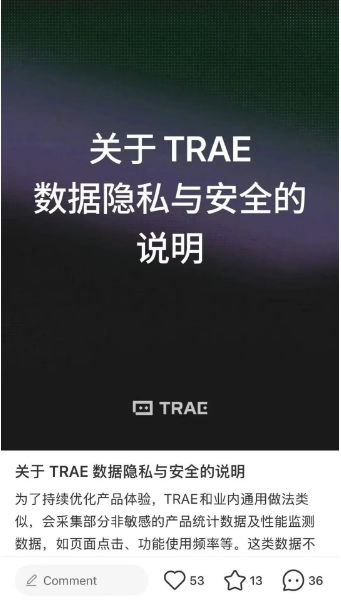
"The collected data pertains to product statistics and performance monitoring—such as page clicks and function usage frequency—and does not include personal identity or private information. We strictly comply with all relevant data protection regulations."

The company attributed the telemetry confusion to Trae IDE's partial reliance on the open-source VS Code framework. According to ByteDance, disabling telemetry in VS Code only affects native modules, while Trae's independent telemetry mechanism remains active. They pledged to optimize the product for clarity.

Performance and Resource Concerns

Beyond privacy issues, developers have flagged:

  • Memory usage: Tests show Trae consumes over 5x more RAM than VS Code
  • Process management: An unusually high number of background processes
  • Network activity: Constant data transmission impacts system performance

Key Points:

  1. Trae IDE allegedly transmits sensitive user data despite disabled telemetry settings.
  2. ByteDance claims compliance with regulations and plans interface improvements.
  3. The tool faces criticism for excessive resource consumption and opaque operations.
  4. This incident highlights growing developer demands for software transparency.
Enjoyed this article?

Subscribe to our newsletter for the latest AI news, product reviews, and project recommendations delivered to your inbox weekly.

Weekly digestFree foreverUnsubscribe anytime

Related Articles

News

Apple Pressured Musk's X to Fix Grok's AI Image Risks or Face App Store Ban

Behind closed doors, Apple warned Elon Musk's X platform that its Grok AI tool violated App Store policies by generating inappropriate images. Internal documents reveal a months-long battle where Apple repeatedly rejected X's content moderation fixes before approving a revised version. While incidents have decreased, recent tests show users can still circumvent safeguards to create explicit content.

April 15, 2026
AI ethicsApp Store policiescontent moderation
DeepMind's Philosopher Hire: Why AI Labs Need More Than Engineers
News

DeepMind's Philosopher Hire: Why AI Labs Need More Than Engineers

Google DeepMind has made an unusual move by hiring philosopher Henry Shevlin in a full-time position - a first for leading AI labs. His focus on machine consciousness and human-AI relationships signals a shift from viewing AGI as purely an engineering challenge to recognizing its profound philosophical implications. As AI systems grow more sophisticated, questions about consciousness boundaries and ethical frameworks can no longer be avoided.

April 15, 2026
AI ethicsMachine consciousnessAGI development
News

Honor and ByteDance Eye Deeper AI Phone Partnership

Honor is in advanced talks with ByteDance to expand their AI collaboration, potentially bringing system-level integration of Doubao's technology to Honor smartphones. The partnership, which began cautiously in 2024, has evolved through multiple AI initiatives and now appears poised for deeper technical cooperation. This move signals how smartphone makers and AI platforms are progressing from app-level to system-level integration.

April 13, 2026
HonorByteDanceAI smartphones
Voice Actors Sound Alarm Over AI Voice Theft Epidemic
News

Voice Actors Sound Alarm Over AI Voice Theft Epidemic

Prominent Chinese voice actors are fighting back against rampant AI voice cloning that's stealing their livelihoods. Zhang Jiaming, famous for voicing Taiyi Zhenren in 'Ne Zha,' reveals he found over 700 unauthorized uses of his voice in a single day. The industry is rallying with legal action as AI-generated voices flood the market, leaving human performers struggling to compete with free digital replicas of their own talent.

April 13, 2026
AI voice cloningvoice actor rightsdigital copyright
News

Voice Actors Fight Back as AI Steals Their Livelihoods

Popular voice actors, including the voice of Taiyi Zhenren from 'Ne Zha,' are losing work to AI clones of their voices. With contracts canceled and infringements rampant, the industry is uniting to push back. Legal battles highlight the deep challenges of protecting vocal identities in the AI era.

April 13, 2026
AI voice theftvoice acting crisisdigital rights
News

ByteDance's AI Brain Drain: 70 Key Staff Flock to Rivals

ByteDance's elite Seed AI team is bleeding talent at an alarming rate, with nearly 70 technical experts jumping ship in just one year. Most have landed at tech giants Tencent and Alibaba, while others are fueling a wave of AI startups. Despite offering lucrative monthly stock options worth up to ¥135,000, ByteDance is struggling to stem the tide in China's cutthroat AI talent wars.

April 10, 2026
ByteDanceAI Talent WarTech Industry