
Amazon Launches AI-Powered Code Editor Kiro

Amazon Launches AI-Powered Code Editor Kiro

Amazon Web Services (AWS) has officially launched Kiro, a new AI-powered integrated development environment (IDE) designed to revolutionize software development. The tool emphasizes specification-driven development, addressing inefficiencies in traditional coding methods. Kiro supports free use of Claude 4/3.7 Sonnet and aims to streamline the development process from prototyping to production.

Core Innovation: Specification-Driven Development

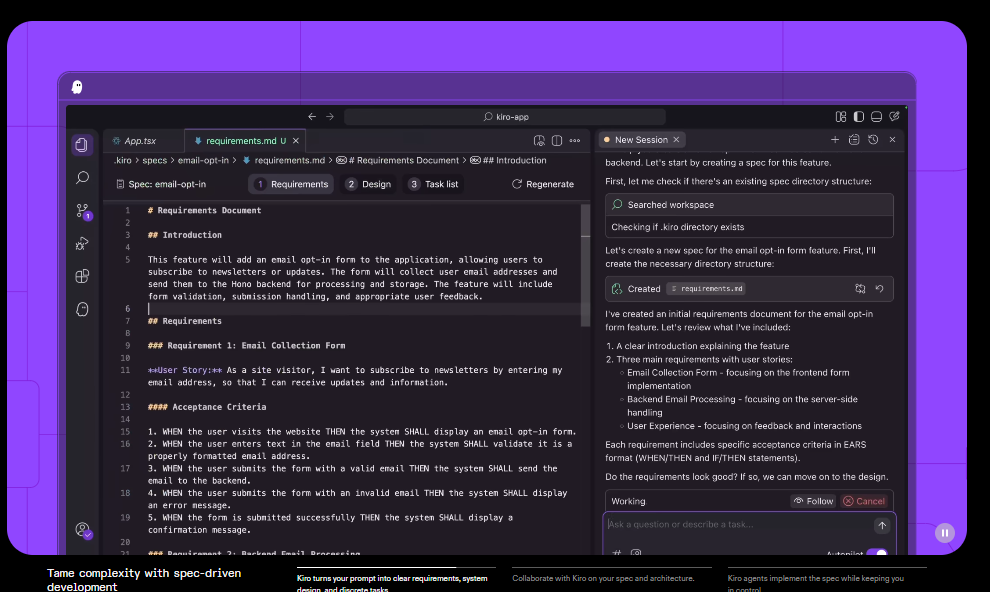
Unlike traditional AI code generation tools like GitHub Copilot or Google Gemini CodeAssist, Kiro focuses on creating detailed requirement documents and system designs before generating code. For example, when a developer inputs a prompt like "Add a comment system to the product," Kiro generates user stories, data flow diagrams, and API endpoints. This approach ensures code clarity and reduces technical debt.
Image

Compatibility and Flexibility

Kiro is built on the open-source Code OSS platform, making it compatible with Visual Studio Code settings and plugins. It also supports the Model Context Protocol (MCP), allowing developers to connect external tools. Currently, Kiro defaults to using Anthropic's Claude Sonnet models but plans to support more AI models in the future.

Key Features: Automation and Collaboration

Kiro introduces innovative features like Agent Hooks, which automate tasks such as generating unit tests and updating documentation. The Adaptive UI dynamically adjusts based on the developer's workflow, providing an intuitive experience. Additionally, Kiro supports multimodal input, enabling developers to upload hand-drawn diagrams that are converted into AWS CDK code.

Free Preview and Future Plans

Kiro is currently in a free preview phase for macOS, Windows, and Linux systems. Amazon plans to release both free and paid versions in the future, with assurances that paid users' code data will not be used for model training. An AWS executive stated that Kiro aims to "redefine how developers build software."

Market Competition and Industry Impact

The launch of Kiro places Amazon in direct competition with tools like Cursor, Windsurf, and Microsoft's Visual Studio Code Agent Mode. Google recently acquired the Windsurf team for $2.4 billion, intensifying competition in the AI coding tool market. Amazon CEO Andy Jassy highlighted Kiro's potential to "change the way developers build software."

Key Points

  • Specification-Driven Development: Kiro emphasizes creating detailed requirements before generating code.
  • Compatibility: Built on Code OSS, Kiro works seamlessly with VS Code plugins.
  • Automation: Features like Agent Hooks automate repetitive tasks.
  • Free Preview: Currently available for free on multiple platforms.
  • Market Competition: Competes directly with tools like Cursor and Windsurf.

Enjoyed this article?

Subscribe to our newsletter for the latest AI news, product reviews, and project recommendations delivered to your inbox weekly.

Weekly digestFree foreverUnsubscribe anytime

Related Articles

Anthropic's Cowork Brings AI Power to Your Desktop—No Coding Required
News

Anthropic's Cowork Brings AI Power to Your Desktop—No Coding Required

Anthropic unveils Cowork, a game-changing tool that lets everyday users harness AI agents without touching a command line. Integrated into Claude's desktop app, it simplifies tasks like file organization and data analysis through natural conversation. Currently in preview for Claude Max subscribers, Cowork represents a major step toward mainstream AI adoption.

January 13, 2026
AI accessibilityClaudeproductivity tools
Mugen3D Turns Single Photos Into Stunning 3D Worlds
News

Mugen3D Turns Single Photos Into Stunning 3D Worlds

A groundbreaking AI tool called Mugen3D is transforming how we create 3D content. Using advanced 3D Gaussian Splatting technology, it can generate remarkably realistic models from just one image - capturing textures, lighting, and materials with astonishing accuracy. This innovation promises to democratize 3D creation across industries from gaming to e-commerce.

January 12, 2026
AIComputerGraphicsDigitalCreation
News

Qualcomm and Google Join Forces to Revolutionize Car Tech with AI

Qualcomm and Google are teaming up to tackle one of the automotive industry's biggest headaches: fragmented in-car systems. Their new 'Automotive AI Agent' combines Qualcomm's Snapdragon Digital Chassis with Google's Android Automotive OS, promising smoother development and smarter features like facial recognition. The partnership also introduces cloud-based development tools that could cut R&D time significantly. This collaboration marks a major step toward more unified, intelligent vehicle systems.

January 9, 2026
automotive-techAIsmart-cars
News

Bosch Bets Big on AI with €2.5 Billion Push Into Smart Cars

At CES 2026, automotive giant Bosch unveiled plans to invest over €2.5 billion in AI development by 2027, targeting smarter cockpits and safer autonomous driving systems. The German supplier aims to transform from hardware specialist to software leader, projecting its tech division could hit €10 billion in sales by the mid-2030s.

January 7, 2026
BoschAIautonomous vehicles
MiniMax IPO Fever: Hong Kong Investors Flock to China's AI Pioneer
News

MiniMax IPO Fever: Hong Kong Investors Flock to China's AI Pioneer

MiniMax, China's rising star in AI technology, has concluded its Hong Kong IPO with staggering investor enthusiasm. The offering saw subscriptions oversubscribed by 1,209 times, raising over HK$253 billion. Backed by heavyweight investors like Alibaba and Abu Dhabi Investment Authority, MiniMax is set to become one of the fastest-growing AI companies ever to go public when it lists on January 9.

January 6, 2026
AIIPOHongKongMarkets
NVIDIA CEO Hails Open-Source AI Breakthroughs at CES 2026
News

NVIDIA CEO Hails Open-Source AI Breakthroughs at CES 2026

At CES 2026, NVIDIA's Jensen Huang made waves by championing open-source AI development, singling out DeepSeek-R1 as a standout success. The tech leader revealed NVIDIA's plans to open-source training data while showcasing their new Vera Rubin chip. Huang outlined four key areas where AI is transforming industries, predicting these changes will define future technological paradigms.

January 6, 2026
AIOpen SourceNVIDIA