

AI Stumbles on Ancient Chinese Scripts: New Benchmark Exposes Weaknesses
When Modern AI Meets Ancient Scripts
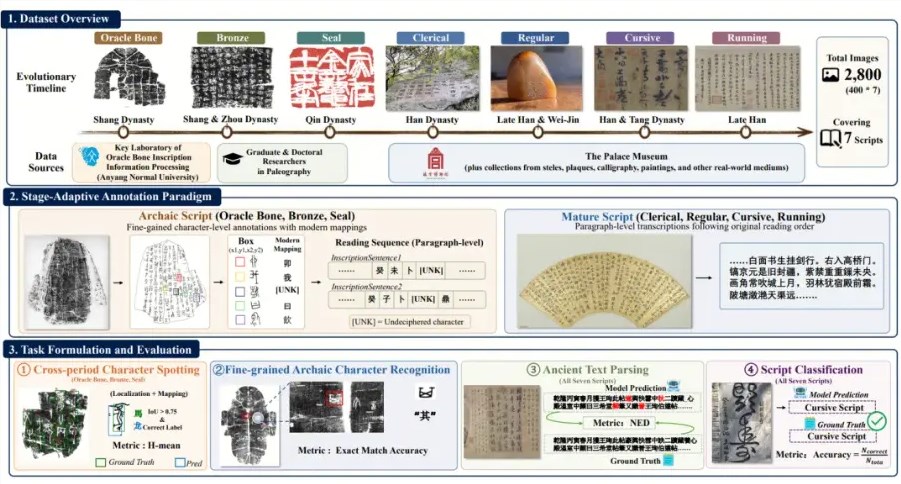
Imagine showing your smartphone to Confucius - now reverse that scenario. Today's most advanced artificial intelligence systems, capable of processing modern code with ease, are surprisingly helpless when faced with writing from three millennia ago.
A consortium including Tencent's Hunyuan research team, SSV Digital Culture Lab, and the Palace Museum has developed Chronicles-OCR, the first comprehensive benchmark for evaluating AI on Chinese ancient scripts. Covering the complete evolution of Chinese characters across seven historical forms, this project delivers sobering news about our tech's limitations.
The Testing Ground
The team compiled 2,800 carefully balanced images of ancient texts, from oracle bone inscriptions to cursive script. Each received meticulous annotation - character-level for early scripts like oracle bone and bronze writings, sequence-level for later standardized forms. This multi-layered approach creates what researchers call "the most rigorous test yet" for visual AI models.
When put through four progressively challenging tasks that separate visual perception from semantic understanding, the results shocked even the developers. Twenty-eight leading models including GPT-5 and Claude Opus failed spectacularly at basic detection tasks, with even the best performer managing just 27.1% accuracy in fine-grained recognition.
Where AI Gets Lost
The failures reveal fascinating blind spots in current technology:
- Texture Over Content: Models frequently confused writing styles based on the material (bone vs bronze) rather than actual stroke patterns
- Reasoning Backfires: Activating advanced reasoning modules actually decreased performance by amplifying perceptual uncertainties
- Microscopic Blindness: Current systems lack sensitivity to subtle brush stroke variations crucial for distinguishing historical scripts
"These aren't just technical limitations," notes one researcher involved. "They represent gaps in how we've trained AI to understand human cultural expression."
Why This Matters Beyond Tech Circles
Chinese characters carry an unbroken chain of civilization stretching back to the Shang Dynasty. The ability to digitally preserve and interpret these artifacts isn't just an academic exercise - it's about maintaining living connections to our shared past.
The open-sourcing of Chronicles-OCR represents both a challenge and invitation to the AI community. By making these shortcomings visible, researchers hope to spur development toward systems that don't just scan characters, but truly comprehend their historical context.
Key Points:
- First comprehensive benchmark for Chinese ancient script recognition reveals major AI shortcomings
- Top models score below 30% accuracy on crucial identification tasks
- Current visual AI focuses on material textures rather than meaningful stroke patterns
- Open-source release aims to guide future development toward cultural understanding