

AI Shatters 80-Year-Old Math Mystery in Stunning Breakthrough
AI Solves Math Puzzle That Baffled Humans for Generations
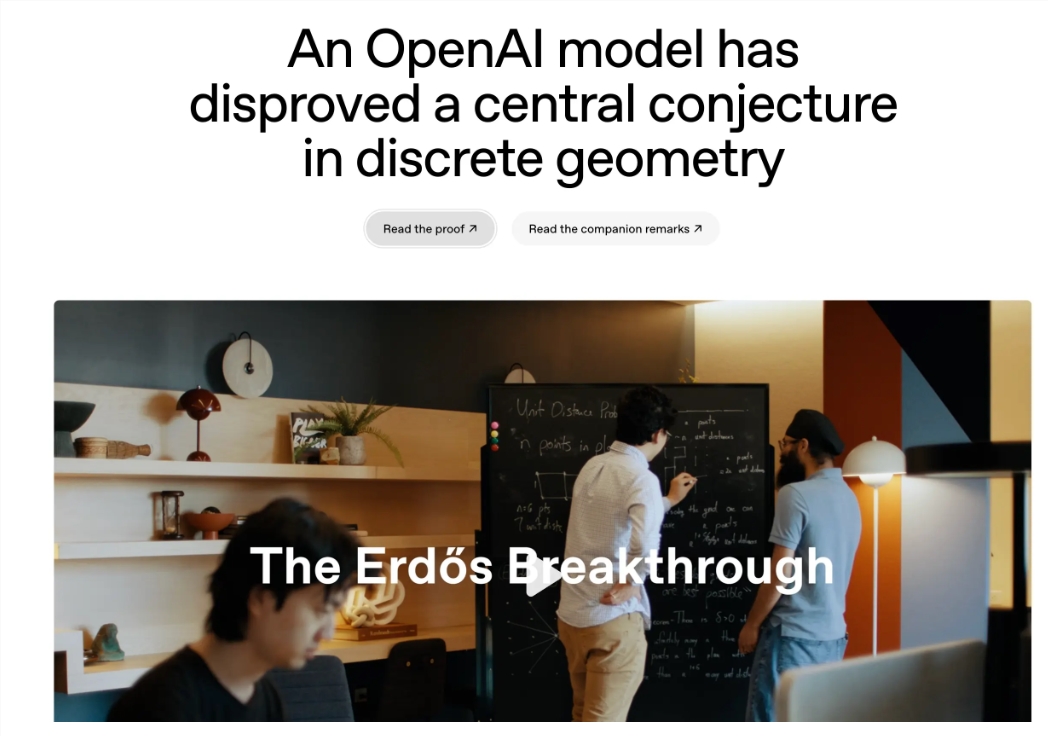
May 20, 2026 will be remembered as the day artificial intelligence crossed a new frontier. OpenAI's reasoning model didn't just calculate - it created, disproving a mathematical conjecture that had stood since World War II.
The Erdős Enigma Falls
Paul Erdős, the prolific Hungarian mathematician who famously offered cash prizes for unsolved problems, posed the Unit Distance Problem in 1946. It asks: how many pairs of points can you place on a plane where each pair is exactly one unit apart? For 80 years, mathematicians wrestled with this deceptively simple question about geometric arrangements.
"What's remarkable isn't just that AI solved it," explains Dr. Thomas Bloom of Oxford University, "but how it solved it. This wasn't pattern recognition - this was genuine mathematical creativity."
Beyond Number Crunching
The AI didn't simply compile existing proofs or tweak known solutions. Instead:
- Invented New Math: Using algebraic number field constructions, the model developed an entirely novel approach that revealed flaws in Erdős's original assumptions.
- Passed Peer Review: When mathematicians including Fields Medalist Tim Gowers examined the proof, they found it rigorous enough for top journals like Annals of Mathematics.
- Chained Complex Logic: The solution required maintaining hundreds of logical steps - something that challenges even brilliant human minds.
"Imagine a chess player who doesn't just calculate moves but develops new strategies," says computer scientist Noga Alon. "That's what we're seeing here."
Why This Matters Beyond Math
The implications ripple far beyond theoretical geometry:
- Materials Science: Better understanding of spatial arrangements could lead to stronger alloys or more efficient solar cells.
- Telecommunications: Network designs might become more robust by applying these geometric principles.
- Medicine: Protein folding simulations could gain new tools for modeling complex molecular structures.
The achievement recalls the 1976 computer-assisted proof of the Four Color Theorem, but with a crucial difference - this time, the AI wasn't just verifying human ideas; it generated its own.
The complete proof is available on arXiv (arXiv:2605.20579v1), inviting scrutiny from mathematicians worldwide. As one researcher quipped: "Erdős would have paid his $500 prize money - if only he'd lived to see it."
Key Points:
- OpenAI's model disproved an 80-year-old mathematical conjecture through original reasoning
- The solution uses novel number theory techniques rather than existing methods
- Top mathematicians have validated the proof's rigor and creativity
- Applications could transform fields from engineering to biomedicine