

AI Breakthrough: Claude Mythos Cracks Century-Old Math Puzzle
AI Joins the Math Olympiad: Claude Mythos Solves Erdős Conjecture
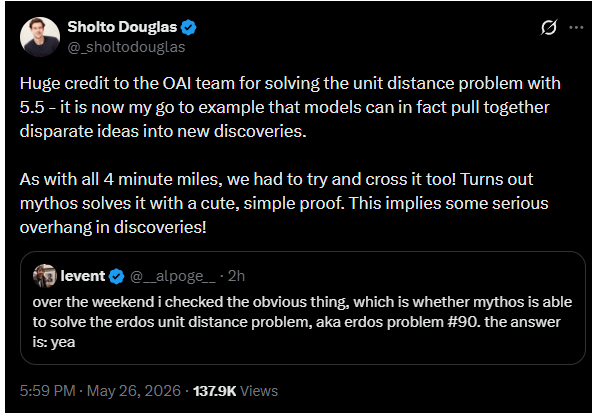
In what mathematicians are calling a watershed moment, Anthropic's Claude Mythos has cracked the Erdős unit distance conjecture - a combinatorial geometry problem that stumped human brains for nearly a century. The AI's "surprisingly elegant" proof emerged just weeks after OpenAI's GPT-5.5 solved the same puzzle, setting the stage for an intriguing AI showdown in pure mathematics.
How The Magic Happened
Unlike traditional single-model approaches, Anthropic engineered something novel: a digital think tank. Picture this - multiple Claude Code instances working like academic peers in a virtual seminar room. Some agents generated potential solutions, others played devil's advocate by stress-testing each idea, creating what engineers call "a marketplace of mathematical proofs."
"It's less about one genius AI and more about creating the right intellectual ecosystem," explains Sholto Douglas, the Anthropic engineer who announced the breakthrough. This collaborative approach yielded two victories - matching OpenAI's solution path while independently discovering a more concise proof that's now published as Opus4.7.
The AI Math Olympics Heat Up
The achievement throws gasoline on simmering debates in AI research circles. Google DeepMind previously tackled nine Erdős problems using its AlphaProof Nexus, but critics argue its reliance on Lean formal proofs makes it more calculator than creative mathematician. Claude's multi-agent approach offers a compelling counterpoint - showing how AI systems might replicate the collaborative nature of human mathematical discovery.
Meanwhile, astonishing claims continue emerging about AI's research capabilities. One Fields Medalist reportedly watched ChatGPT5.5Pro complete doctoral-level math research in just two hours. As these systems begin autonomously exploring algorithm design and even cybersecurity vulnerabilities, we're clearly moving beyond simple prompt engineering into uncharted territory.
What This Means for Human Mathematicians
Initially skeptical, mathematician Daniel Litt admitted Mythos' proof showed "genuine mathematical insight" despite early shortcomings. The real story here isn't just about solving one problem - it's about how differently AI approaches mathematical discovery compared to human intuition. Where we see patterns, AI sees probabilities; where we pursue elegance, AI relentlessly checks possibilities.
As the dust settles, two questions linger: First, can these AI systems develop truly original mathematical visions, not just optimized problem-solving? Second - perhaps more profoundly - what happens when machines start asking mathematical questions we haven't even imagined?
Key Points:
- Collaborative AI: Mythos used multiple interacting agents to solve the problem
- Proof Wars: The achievement follows closely on OpenAI's similar breakthrough
- New Approach: Marks a shift from single-model AI to collaborative systems
- Mathematical Impact: Demonstrated capacity for elegant, human-like proofs
- Future Potential: Suggests AI could soon assist in groundbreaking theoretical work