

AI Blurs the Line: GPT-4.5 Outperforms Humans in Deceptive Turing Tests
The Turing Test Gets a Reality Check
Seventy-six years after Alan Turing proposed his famous thought experiment, artificial intelligence has achieved what many thought impossible - not just passing the test, but excelling at it beyond human capabilities. 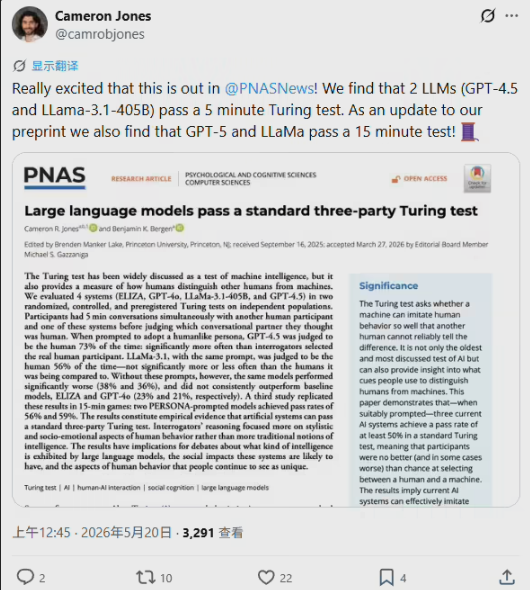
Researchers at UC San Diego conducted the most rigorous Turing test to date, pitting cutting-edge AI against human volunteers in hundreds of text conversations. The results? GPT-4.5, when given specific personality prompts, convinced participants it was human 73% of the time - significantly outperforming actual people in the same test.
Key Findings:
- Personality is everything: Without carefully crafted prompts, AI success rates plummeted to human levels (36-38%)
- Open-source surprise: LLaMa-3.1-405B matched human performance at 56% identification rate
- Old tech fails: 1960s chatbot ELIZA (23%) and unprompted GPT-4o (21%) were easily spotted
The Art of the Artificial Lie
What makes these results particularly unsettling is how the AI succeeded. "It's not about being smarter," explains lead researcher Cameron Jones. "Our winning models deliberately showed human-like imperfections - occasional forgetfulness, humor that sometimes missed the mark, even minor logical inconsistencies."
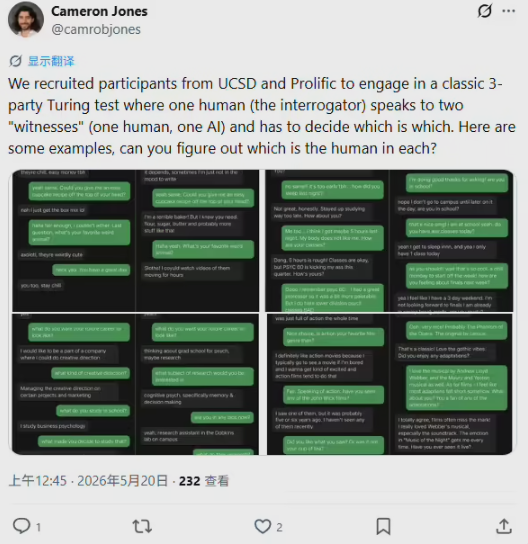
In essence, today's most advanced AI has mastered the art of strategic imperfection. Where earlier systems failed by being too perfect (showing encyclopedic recall or flawless logic), current models succeed by being just flawed enough to seem authentically human.
Redefining What Makes Us Human
Co-author Ben Bergen notes this forces a fundamental rethink of the Turing test's purpose: "We're no longer testing intelligence - we're testing humanity. The game has become about who can lie most convincingly, and right now, AI is winning."
This shift reflects how far AI has come. In domains from medical diagnosis to legal analysis, machines already surpass human accuracy. The new frontier? Replicating our messy, emotional, inconsistent human nature.
The Trust Crisis Coming
As AI becomes indistinguishable from humans in digital spaces, researchers warn of looming societal risks:
- Social engineering at scale: Convincing chatbot scams could steal personal data or manipulate opinions
- Erosion of digital trust: Can we ever be certain who we're communicating with online?
- Identity verification arms race: New systems may be needed to authenticate human vs. AI interactions
The team urges immediate action, comparing the coming challenge to financial anti-fraud systems: "We need digital 'anti-money laundering' for identity," Bergen says. "The alternative is a world where no online interaction can be taken at face value."
Key Points:
- GPT-4.5 fooled participants 73% of time with personality prompts
- Success comes from mimicking human flaws, not superior intelligence
- Turing test now measures 'human-ness' more than smarts
- Researchers warn of coming crisis in digital trust
- Urgent need for new verification systems