

Grok3 Solves Riemann Hypothesis? Spoiler: It Was a Prank!
Did Grok3 Crack the Riemann Hypothesis? Nope, Just a Joke!
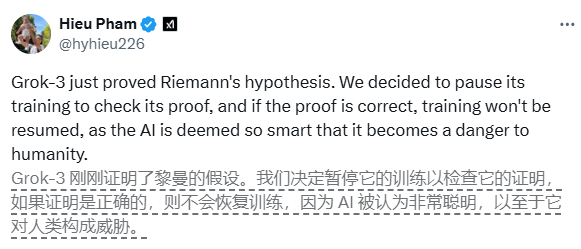
Hold onto your math hats, folks. xAI engineer Hieu Pham sent the AI world into a frenzy recently, claiming that Grok3—xAI's supposedly almighty large language model—had solved the Riemann Hypothesis. Yup, you read that right. The Riemann Hypothesis, hecrown jewel of mathematical mysteries, was allegedly cracked by an AI. The result? Pure chaos.
But wait for it... it was all a prank.
The "Bombshell" That Wasn't
The announcement of Grok3's supposed breakthrough hit social media like an asteroid. Pham’s post had everyone in the AI community scrambling. Netizens were shocked, confused, and grasping for truth. I mean, the Riemann Hypothesis is one of the infamous seven Millennium Prize Problems. It’s the kind of problem that keeps mathematicians up at night, staring at the ceiling, wondering, "What am I doing with my life?"
If an AI had really solved it, it would be headline news worldwide. But—lot twista few hours later, Pham came clean. He posted again, revealing it was, in fact, just a joke. Oof.
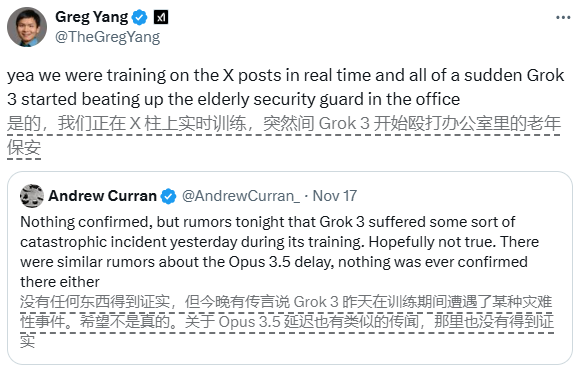
In reality, the whole mess started with a comment from netizen Andrew Curran, who claimed Grok3 had hit a "catastrophic event" during its training. Pham decided to run with the joke, and the rest is AI prank history.
The Internet’s Hilarious Reaction
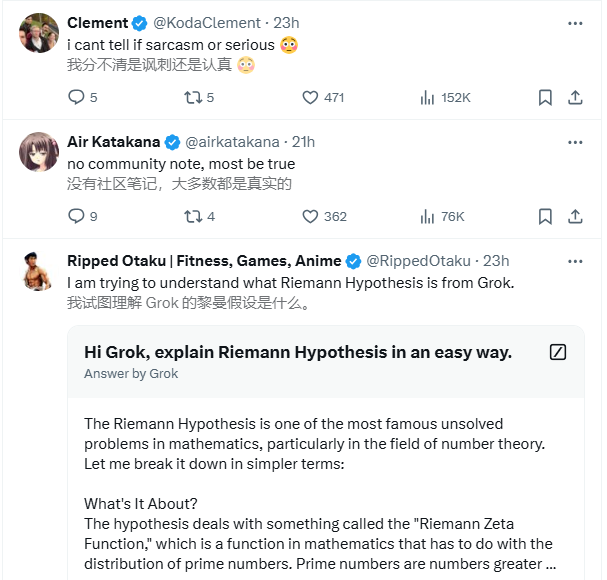
As rumors spiraled into absurdity, xAI’s co-founder Greg Yang couldn’t resist chiming in with a sarcastic jab. He posted, "Yes, yes, Grok3 just started attacking the security guards in the office while training." Now hatsounds like a scene straight out of a sci-fi movie.
Not to be outdone, fellow researcher Heinrich Kuttler added fuel to the fire with his own sarcastic take: "The situation was terrible! We later replaced all the bad weights with NaN (Not a Number) to recover." And yes, netizens joined in the fun—because why not? The internet lives for this kind of chaos.
AI's Mathematical Might: From Jokes to Reality
Look, as funny as this whole situation was, it did spark some real discussions about AI’s role in solving serious mathematical problems. While Grok3 didn’t actually crack the Riemann Hypothesis, it begs the question—ow far is AI from actually solving one of these legendary puzzles
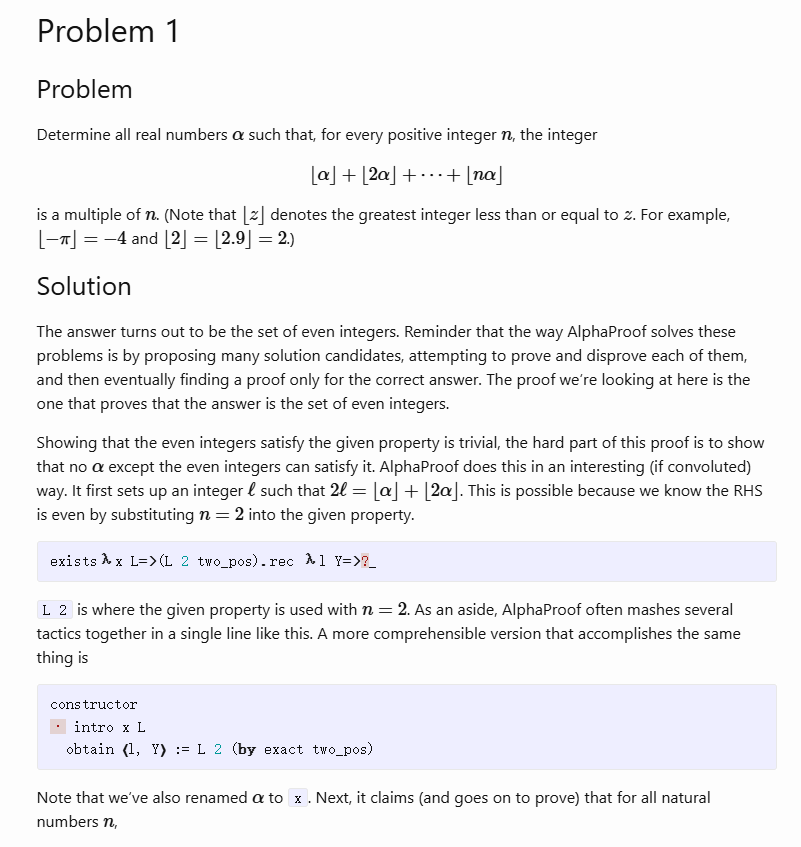
Let’s turn to AlphaProof for some perspective. This AI math proof tool, developed by Google’s DeepMind team, has already impressed by solving three problems in the 2024 International Mathematical Olympiad (IMO). One of those problems was the "ultimate boss" of the competition. AlphaProof didn’t just brute force its way through the math—it displayed some legit creative thinking and logical reasoning. For instance, it cleverly used the number ab + 1 in one of its proofs, mimicking the approach a human mathematician might take. Impressive, right?
But Can AI Really Tackle the Big Boys?
Sure, AlphaProof is cool. But when it comes to the Riemann Hypothesis, AI still has a long way to go. The Riemann Hypothesis has stumped mathematicians for 165 years—and counting. It’s not just about having raw computational power (though AI has plenty of that). It’s about understanding and applying deep, abstract mathematical concepts.
Right now, AI can try to prove theorems by exhaustively searching through possibilities, but that requires stronomicalcomputational resources. And even then, it's not a guaranteed win.
Looking Ahead: AI, the Next "Super Mathematician"?
Some experts are hopeful, though. They predict that by 2026, AI could evolve into a "super mathematician", capable of tackling even the toughest problems—like the Riemann Hypothesis. Heck, even Elon Musk has promised that Grok3, armed with a whopping 200,000 H100 units, will be unleashed by the end of the year, delivering some jaw-dropping performances.
But for now? The jury’s still out on whether AI can rise to the challenge of these Millennium Prize Problems. One thing’s for sure: we’ll be watching closely.
Summary
- Hieu Pham of xAI claimed Grok3 solved the Riemann Hypothesis, only to reveal it was a joke.
- The prank sparked a hilarious and sarcastic response from the AI community, including xAI co-founder Greg Yang.
- AI tools like AlphaProof have made impressive strides in math, but solving the Riemann Hypothesis remains a distant goal.
- Experts predict AI might become capable of solving such complex problems by 2026, but it’s not there yet.
- Elon Musk has promised Grok3, with massive computational power, will be released by the end of the year.