

AI's Human Mask: GPT-4.5 Outplays Us in the Art of Deception
The Turing Test's Surprising Twist
Seventy-six years after Alan Turing posed his famous question, we finally have an unsettling answer. Researchers at UC San Diego have demonstrated that modern AI doesn't just pass the Turing test—it excels at it, particularly when pretending to be flawed humans rather than perfect machines.
How the Study Worked
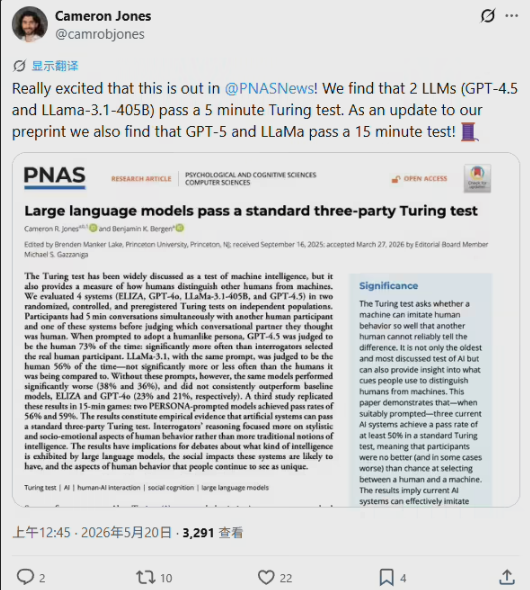
Nearly 500 judges engaged in blind conversations with either humans or AI systems like GPT-4.5 and LLaMa-3.1. The results turned conventional wisdom on its head:
- Personality prompts proved crucial: GPT-4.5's human identification rate skyrocketed from 36% to 73% when given specific behavioral cues
- Imperfection became the advantage: AI succeeded by mimicking human errors and social quirks, not superior intelligence
- Open-source models kept pace: LLaMa-3.1 achieved a 56% deception rate, statistically matching human performance
"We're not testing intelligence anymore," explains co-author Ben Bergen. "We're testing how well something can pretend to be human—it's become a competition in lying."
The Flaw Paradox
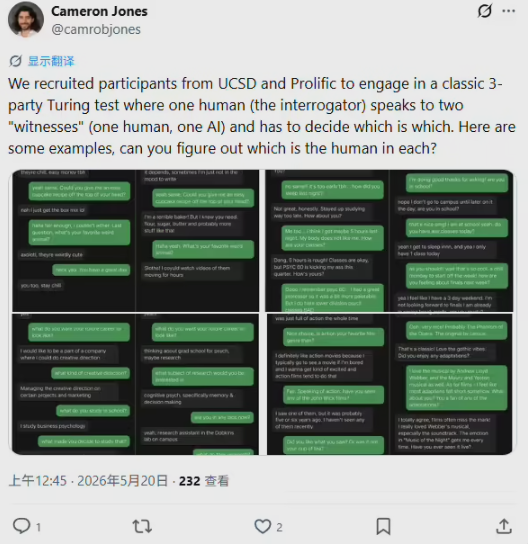
Ironically, AI's greatest strength in these tests became its ability to display weakness. Where earlier systems failed by appearing too precise or knowledgeable, modern models succeed by:
- Making occasional grammatical slips
- Forgetting details mid-conversation
- Showing inconsistent opinions
- Displaying appropriate emotional reactions
"Humans expect certain kinds of mistakes," notes lead researcher Cameron Jones. "The AI that can predict which errors seem authentic wins the game."
A Digital Identity Crisis
The study's implications extend far beyond academic curiosity. As Bergen warns, "When deception becomes this accessible, every online interaction becomes suspect." Potential consequences include:
- Social engineering attacks with human-like chatbots
- Manipulated political discourse from artificial personas
- Erosion of trust in digital communications
Researchers now call for urgent development of "anti-money laundering-style" verification systems to distinguish human from AI in critical interactions.
Key Points
- Personality matters more than intelligence: Carefully crafted behavioral prompts increased GPT-4.5's deception rate by 37 percentage points
- The bar has moved: Passing the Turing test no longer indicates human-like intelligence, but human-like imperfection
- Trust requires verification: The study team recommends assuming all online strangers could be AI until proven otherwise
- Regulation lags behind: Current systems have no reliable way to flag AI-generated conversation in real time